 Ironstone
To sell websites on cold calls, build the finished website first, then call to show it, not to pitch. Pick one business type in your town with a gap the owner can see. Call the listing's number at a quiet hour. Say who you are, the gap you found and that the fix is already built. Ask to send the link while you're on the line. Follow up once by email, and send an approval link on a yes. Cold calling works when the call is about something the owner can open.
Key facts
- In Pew Research Center's survey of 10,211 US adults, July 13 to 19, 2020, 19% said they answer their cellphone when an unknown number calls. 1
- In Clutch's survey of 406 US small business owners on August 5, 2025, 40% of small businesses without a website said they rely on referrals as their main source of leads. 2
- In a survey of 500 small and midsize business decision-makers by Clutch and Drive Research, 81% said clear and consistent communication is the most important factor when they select service providers, consultants or business partners. 3
- In Ironstone's own records, Lead finder showed 6 partners 56 local businesses with a gap an owner can see between October 8 and November 17, 2026 (our own accounts left out). 4
- In Ironstone's own records, of the 56 businesses with a gap Lead finder showed partners between October 8 and November 17, 2026, 28 had no website it could find (our own accounts left out). 4
Does cold calling for websites work?
Yes, cold calling works when the call is about a website already built for that business, and its only job is to get the owner to open the link. It fails as a pitch for a service the owner can't see. On a good call, the owner judges something finished, on their own phone, while you're still talking. A pitch can't offer that.
Let's be honest about the hard part. Plenty of calls go to voicemail, and owners hear from people selling something every week. But a call about a finished website for their own business sounds different from its first sentence. For the wider question of whether selling websites to local businesses works on every channel, read our post on it.
Picture the owner of Ridgeway Auto Repair, a fictional shop. He picks up the shop phone between jobs, with a car up on the lift. He gives a stranger a sentence or two before he decides. If those sentences name his shop, the gap on his listing and a website already made for him, he asks for the link. If they sound like a sales call, he hangs up.

Why does a phone call still reach local business owners?
A call reaches owners because it's a person's voice, live, about their own business. That's the same way their customers and their referrals reach them: a person, talking. A call costs nothing but your time. Three survey figures below back this up, and one of them is a warning about unknown numbers.
of US adults said they answer their cellphone when an unknown number calls, in Pew Research Center's 2020 survey. Plan every call for a voicemail and a link, not only for a live answer. 1
of small businesses without a website said they rely on referrals as their main source of leads, in Clutch's 2025 survey of US small business owners. Owners who grow by word of mouth are used to a person talking to them, and that's what a call is. 2
of small and midsize business decision-makers said clear and consistent communication is the most important factor when they choose a service provider, in a survey by Clutch and Drive Research. A short, clear call that says exactly what you built is that communication. 3
In a 2025 survey of more than 1,000 people reported by CX Dive, 83% of US consumers had used a search engine to find a local business in the past month. The owner's customers look the business up before they call it. So your call should point to what those customers find there, or don't find. 7
Which businesses are worth a cold call about a website?
Call businesses with a gap the owner can see: no website, one that won't open, a web address someone else owns, a security warning, an old year, only a social or ordering page, or no mobile layout. Lead finder showed 6 partners 56 local businesses with a gap an owner can see between October 8 and November 17, 2026 (our own accounts left out). The table counts them by gap. 4
| What Lead finder found | Businesses, of 56 | First sentence on the call |
|---|---|---|
| No website it could find | 28 4 | I looked for your business online this morning and couldn't find a website, so I built one with your hours and your phone number on it. |
| A listing whose website and name-based web addresses did not open | 14 4 | The website on your map listing doesn't open, so a customer who taps it gets nothing; I built you a new one that does. |
| No website on the listing, and the web addresses matching the name belonged to someone else | 9 4 | The web address with your business name in it belongs to someone else, so I built your website at an address I can send you right now. |
| A website without a secure connection | 7 4 | When I opened your website, my phone warned me it isn't secure, and some customers stop right there; the one I built doesn't show that warning. |
| A website whose newest year was 2021 or earlier | 6 4 | The newest year on your website is a few years back, so I built a version with this year's hours and services. |
| Only a social or directory page for a website | 6 4 | Your listing sends customers to a social page, so I built you a website of your own with your hours, your services and a call button. |
| Only a booking or ordering service where a website should be | 6 4 | Your listing only links to an ordering page, so I built a website with your menu, your hours and your phone number on the first screen. |
| A website with no mobile layout | 5 4 | Your website shrinks to tiny text on a phone, so I built one that fits the screen, with the call button at the top. |
A business can have more than one gap, so the rows add up to more than 56. The counts come from our own records: Lead finder's results for Ironstone partners, with our own accounts left out. The third column is the line to say on the call, because it names the gap and says the fix is already built. 4
How do you sell websites on cold calls in 9 steps?
You sell on cold calls by choosing which owners to call, calling with a short script, offering a look at a new website, answering objections in one sentence and following up by email until the owner approves it. The nine steps below cover that path, each with a script, a checklist and the screen in our app. The full method is in our guide to how to sell AI websites to local businesses. This post is the phone part of it.
1. Which businesses should you call first?
Call businesses of one type in your own town, each with a gap the owner can see, a phone number on its listing and an owner who answers the phone. One type means the same questions, the same objections and the same quiet hours on every call. By the fifth plumber, you know what a plumber will say before he says it.
In the app, Lead finder, our business lookup tool, searches a business type in a town and labels each business by what it found: No website found, Social listing only, Website won't open, Outdated website or Delivery page only. That label is the gap you name on the call. You don't have to guess.
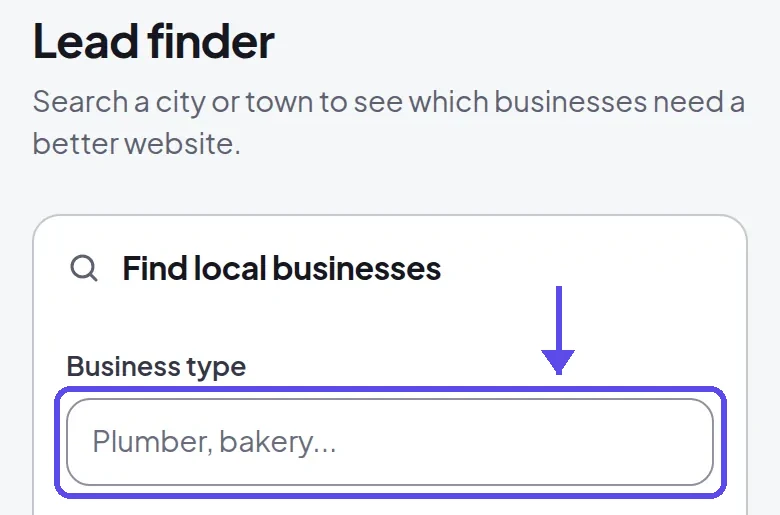
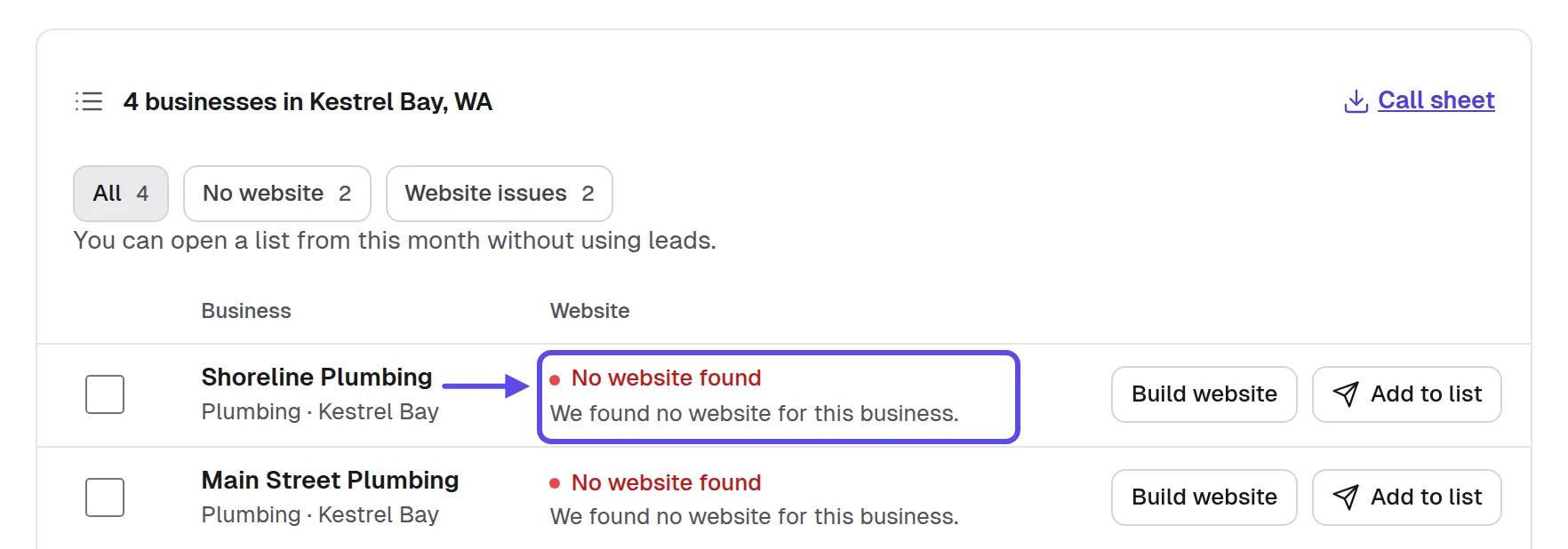
Here's the twist: you need fewer searches than you think. Of 54 Lead finder searches partners ran between October 8 and November 6, 2026, the middle one returned 17 local businesses (our own accounts left out). One search of one type gives you a week of calls. Ten searches give you a list you never get through. 4
To do it by hand, search "[type] near [town]" in Google Maps. Open each listing: no Website button, a social page only, or a link that won't open is a gap. Copy the name, the listing's phone number, the gap and the opening hours into a sheet in Google Sheets. Then add two columns, one for the best hour to call and one for the result.
- One business type, every one of them in your own town
- A phone number on every listing you keep
- One gap per business that you can name in a sentence
- Opening hours copied so you know when each business is open
- No chains or franchises, where a head office makes the call
You'll know it worked when you have a short call list of one business type. Each row has a phone number, the gap and the hours, and you could start dialing tomorrow morning.
Tip
Call the businesses you could also visit in person. If a call goes well, the owner may ask you to come by, and you'll be able to.
2. Which gap will you name in your first sentence?
Name the one gap the owner can check on their own phone while you talk: no website, a website that won't open, a security warning, an old year, or a page that doesn't fit a phone. A gap they can see turns your claim into something they confirm themselves. A vague "your website could be better" gives them nothing to check.
At the middle of 25 checks between October 27 and November 17, 2026, Lead finder checked a business's website for partners in 336 milliseconds, about a third of a second (our own accounts left out). So check every business again on the morning you call. A gap the owner fixed last week makes your first sentence wrong. 4
In Rio SEO's 2025 Local Search Consumer Behavior Study, 53% of US consumers said they're unlikely to visit a business whose online listing has wrong information. So wrong hours on the listing are a gap too, even when the website is fine. Say it as what the customer sees, not as a fault of the owner. 6
By hand, run the website through PageSpeed Insights and read the phone result. Google's web.dev says a page's largest content should load within 2.5 seconds for a good user experience. Then paste the address into the Wayback Machine to see how long the website has looked the same. Write the gap in one plain sentence in your sheet, ready to say on the call. 9
- The gap shows on your own phone today
- One gap per business, not a list of faults
- The gap said as what a customer sees
- The listing's hours checked against the website
- No gap you can't show the owner
You'll know it worked when every row on your call list has one sentence an owner could check on their phone in the time it takes to say it out loud.
Tip
Say the gap as something you saw, not something they did wrong. "I couldn't find your hours" lands better than "your website is broken."
3. Why build the website before you dial?
Because then the call offers something the owner can open in the time it takes to tap a link. A call about a promise asks for trust. A call about a finished website asks for a look, and that's a much smaller favor. When a website takes minutes to build from the business's own listing, building first costs you little.
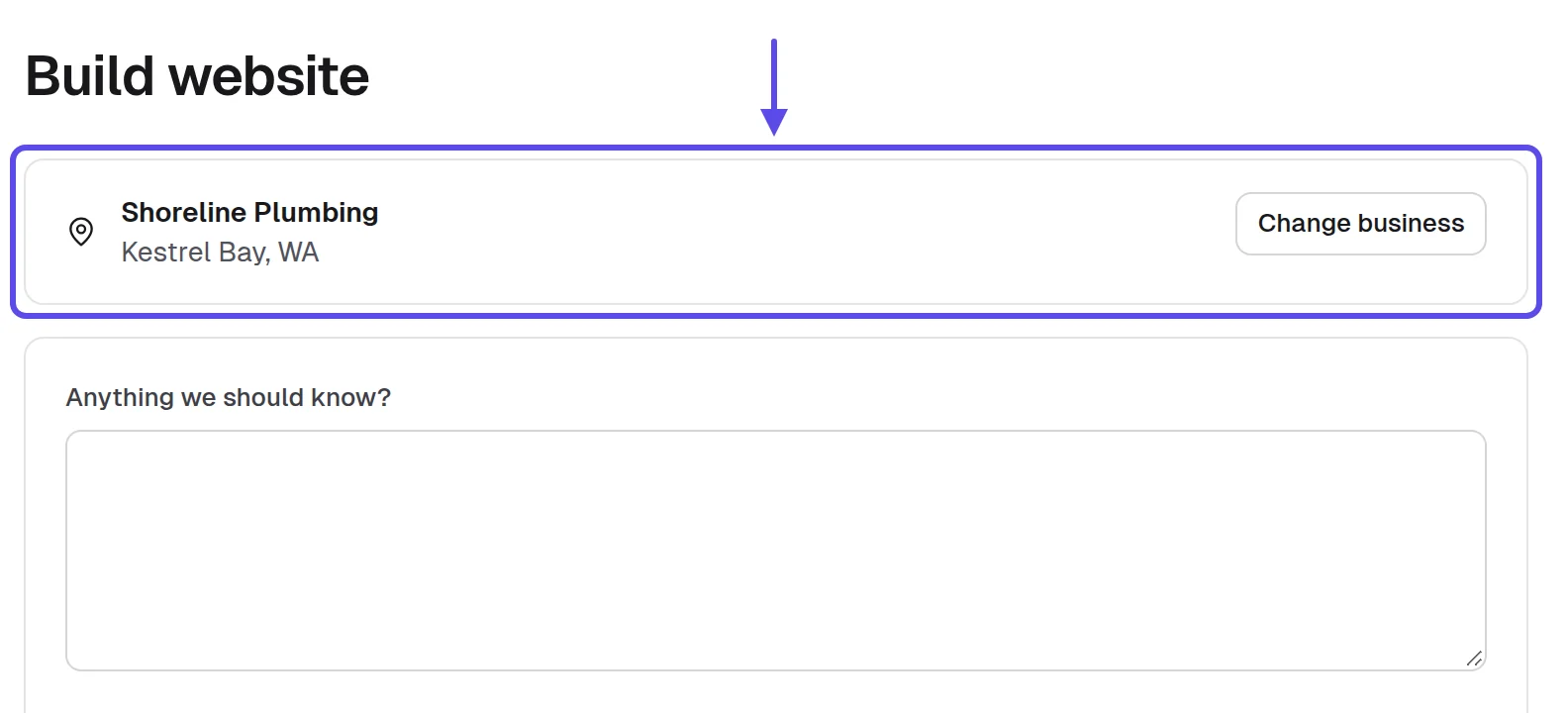
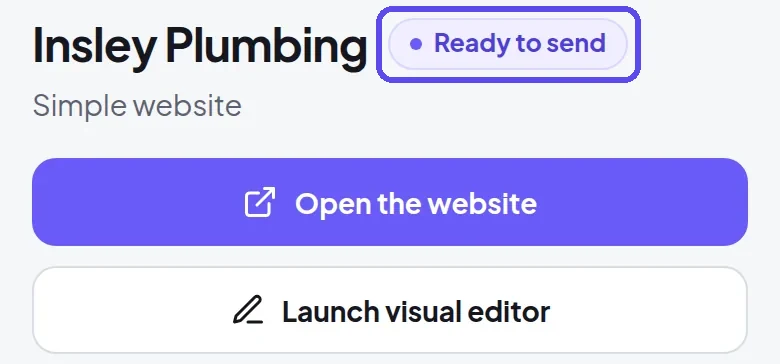
In the app, a build brings in the business's public listing and its current website, with its real hours, services and photos. When it's done, the website is marked Ready to send. Before you call, check every fact against what the business published. You're the last pair of eyes before the owner sees it.
The twist: build the first screen around the gap you'll name on the call. If you'll say "I couldn't find your hours," the hours sit on the first screen. If you'll say "there's no call button," the call button is the first thing they see. The owner then sees the fix the moment the link opens.
Need to change something? Ask in plain words, like "put the hours at the top," and the website updates in a few minutes. Every change is saved as a version you can bring back. By hand, open the finished website on your own phone and read it top to bottom, the way the owner would.
- Name, phone and address match the listing
- The hours on the website match the listing
- The gap's fix is on the first screen
- The call button works from your phone
- Nothing on the website was made up
You'll know it worked when every business on today's call list has a website marked Ready to send, and you've opened each one on your own phone before you dial.
Tip
Never invent reviews, awards or years in business. An owner who spots one made-up line stops trusting the rest.
4. When should you call, and who do you ask for?
Call the number on the listing at the business's quiet hour, and ask for the owner. For a diner, that's between lunch and dinner. For a bakery, it's after the morning rush. For a plumber or a repair shop, call early, before the first job. An owner with a minute to spare will listen to your second sentence. That's why the hour matters as much as the words.
When staff answer, ask when the owner is in and leave your name. Never pitch the person who answers. They can't say yes, and they may say no for the owner. A staff member who already knows your name also makes the second call warmer, because you're no longer a stranger to the business.
Here's what people miss: check the hours on the business's listing in Google Maps before you dial. Never call in the first or last hour the business is open. An owner who's opening up or closing out has no minute for a stranger, even one with good news about their website.
By hand, block your calling hours in Google Calendar, one block per business type at its quiet hour. Write the businesses for each block in the event itself. When the block ends, stop calling and send the follow-ups while each call is still fresh.
When staff answer
Hi, I'm [Your full name] from [Your business name]. I built a website for [Business name] and I'd like to show it to the owner; when's a good time to catch them?
Could you pass on my name and number, [your phone number], so I can call back then?
- The listing's hours checked before you dial
- Calls placed in the business's quiet hour
- Never the first or last open hour
- Ask staff when the owner is in
- Calling blocks booked in your calendar
You'll know it worked when more of your calls reach the owner, or a staff member gives you a time to call back. Write that time in your sheet the moment you hear it.
Tip
When a staff member names a time, call at exactly that time. It shows the owner you keep your word before you've even met.
5. What do you say in the first two sentences?
Say who you are, that you're local, the gap you found and that the fix is already built. Then ask to send the link. The owner decides in those two sentences whether this is a sales call. A sentence about their own business answers that question before they ask it, and it gives them a reason to keep listening.
In Lead finder, under each label is a line you can say to the owner. Read it before you dial, then say it in your own words. The table below gives the opener for five fictional businesses, each one written for its own gap.
| Business (fictional) | What customers can't do today | Your first sentence |
|---|---|---|
| Insley Plumbing, Kestrel Bay | tap through to a website from the listing | Hi, is this the owner of Insley Plumbing? I'm [Your full name], I'm in Kestrel Bay too, and I built you a website because I couldn't find one when I searched for a plumber here. |
| Shoreline Plumbing, Kestrel Bay | open the website on the listing | Hi, is this the owner of Shoreline Plumbing? I'm [Your full name] from [Your business name]; the website on your listing didn't open for me this morning, so I built you one that does. |
| Oatmere Bakery | find the hours and the menu on a phone | Hi, is this the owner of Oatmere Bakery? I'm [Your full name]; I couldn't find your hours or your menu online, so I built a website that shows both. |
| Harbor Light Diner | see the menu without an ordering page | Hi, is this the owner of Harbor Light Diner? I'm [Your full name]; your listing only links to an ordering page, so I built a website with your menu and your hours on the first screen. |
| Ridgeway Auto Repair | read the services on a phone | Hi, is this the owner of Ridgeway Auto Repair? I'm [Your full name]; your website is hard to read on a phone, so I built one with your services and a call button at the top. |
Here's the twist. Open with a question the owner answers yes to, like "is this the owner?" After your offer, stop talking. The silence is where the owner decides, so let it sit. Talk about their customers and their gap, never about AI or design. Those words mean nothing to someone with a car on the lift.
Opening the call
Hi, is this the owner of [Business name]? I'm [Your full name] from [Your business name], here in [your town].
I noticed [the gap you found on your listing]. So I've already built [Business name] a new website, and there's nothing to pay to look at it.
Can I send you the link right now, so you can see it on your phone while we talk?
Would a ten-minute look later this week suit you better?
The voicemail
Hi, this is [Your full name] from [Your business name]. I built a website for [Business name] after I couldn't find your hours online. I'll send you the link by email today. My number is [your phone number]. Again, that's [your phone number].
- The opener written for this business's gap
- Your full name and business name in it
- Say the website is already built
- Ask permission to send the link
- Stop talking after the offer
You'll know it worked when owners answer your opener with a question about their website, like "what did you build?", instead of "we're not interested." That question means they're curious, and curious owners open links.
Tip
Say the opener out loud ten times before your first call. Owners hear the difference between reading and talking.
6. How do you get the owner to open the website while you're on the line?
Ask permission, send the link by text or email while you're still talking, and stay quiet while the owner scrolls. The owner judges the website in the first minute it's open. You're there to answer the first question it raises. A link opened after you hang up gets a glance, not a decision, and you won't hear what the owner thought.
The app writes a first message in your name with the link to the website, and lets you send it by email or text. Every email carries an opt-out line. Follow-ups stop when the business replies, so nobody gets another message after they've answered you. Draft it before you dial, so it's ready the moment the owner says yes.
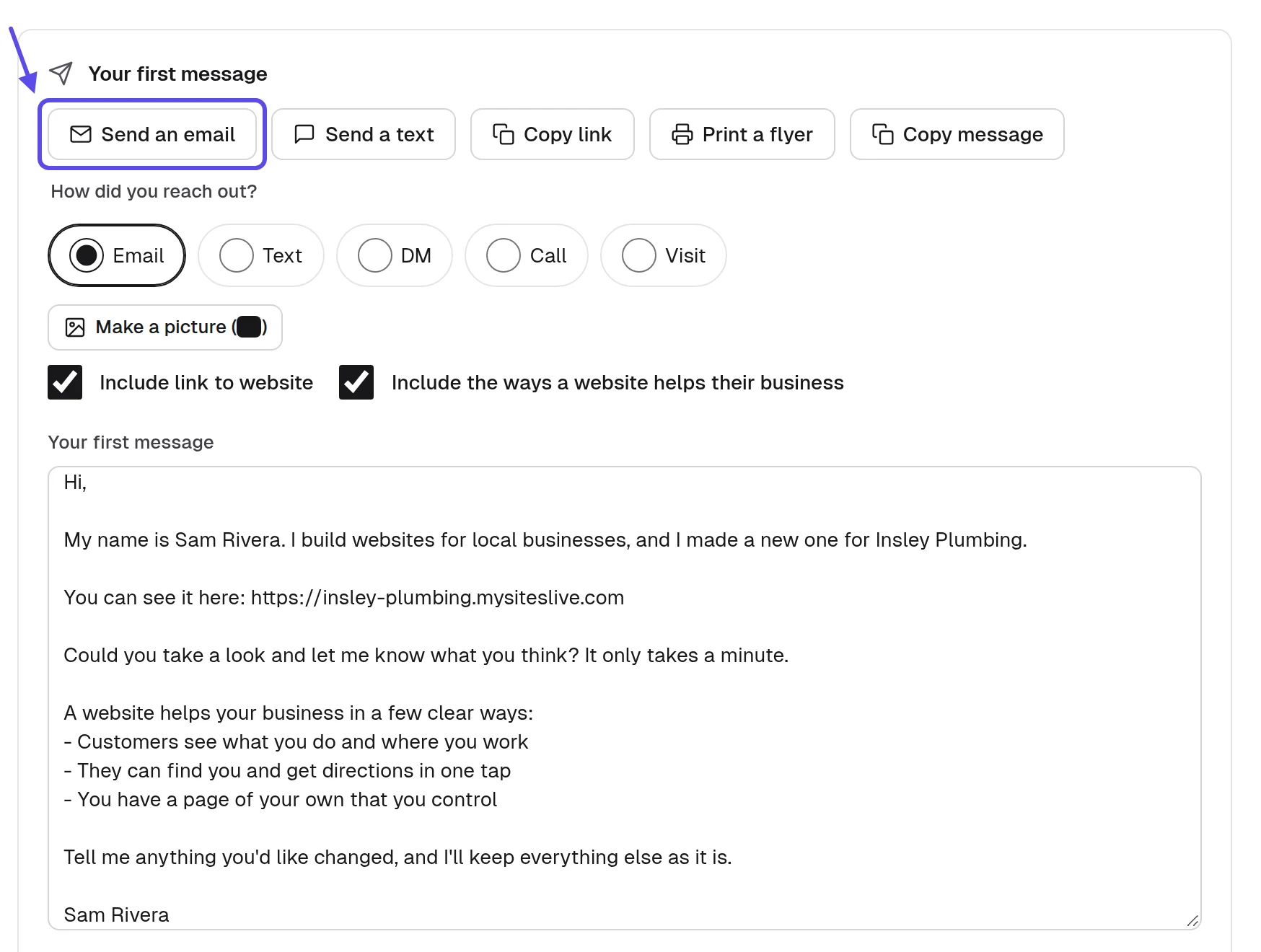
The twist: tell the owner what to look at first, which is the fix for the gap you named, like "your hours are right at the top." Then let them find it themselves. Ask what they'd change, not whether they like it. An owner who names a change is already picturing the website live.
While they scroll
Start at the top, the way a customer would. Your hours and the call button are right there.
What would you want different before your customers see it?
The link by text
Hi, this is [Your full name] from [Your business name], [your phone number], [your address]. Here's the website I built for [Business name] that we're talking about on the phone: [Website link]. Reply STOP to opt out.
By hand, draft the email in Gmail before each call. Put in the business's link, a subject line with its name, your mailing address and an opt-out line. When the owner says yes, press send while you're still talking. Ask them to tell you when it arrives, so you know they have it open.

- Ask before you send the link
- The message drafted before you dial
- Stay on the line until it opens
- Point them to the gap's fix first
- Ask what they'd change, then write it down
You'll know it worked when the owner opens the website while you're on the line and names something to change, or reads their own hours back to you out loud.
Tip
Count to five in silence after the link arrives. The owner's first words about their website tell you more than anything you could add.
7. How do you answer objections before you hang up?
Answer each objection in one sentence, offer the look again, and accept a no the first time it's said clearly. An owner who raises an objection is still on the line. One who hears a speech in reply hangs up, and one who hears a short, honest answer often opens the link. If the owner asks what it costs or says it sounds expensive, give your monthly price in one plain sentence. Then ask what one new customer is worth to them, and offer the look again.
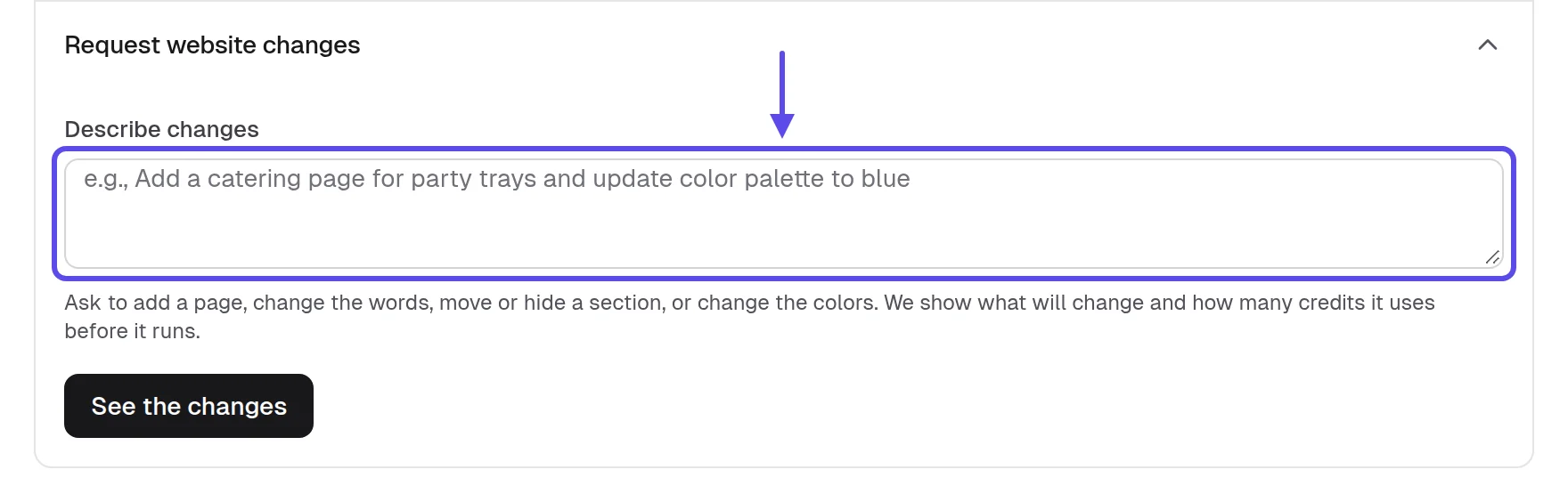
If the objection is about one thing on the website, like "that's not our photo" or "we close earlier on Sundays," say you'll change it today. In the app, you ask for the change in plain words, and the website updates in a few minutes.
We have a website
I looked at your website this morning, and [the gap you saw] is what your customers see first. The new one fixes that, and you can compare both on your phone in a minute.
Email me something
Happy to, and it'll be the link to your own website, not a brochure. Tell me which email address to use, and look for my name in the subject line.
I'm too busy
I get it, this is a bad moment to talk. If a ten-minute look later this week works for you, I can do [day and time] or [day and time], whichever suits you better.
In a survey of 500 small and midsize business decision-makers by Clutch and Drive Research, 74% named long-term partnership potential among the most important factors when they choose service providers and consultants. So answer objections by talking about the months after: who changes the hours, and who answers when something breaks. Don't spend the call on the build. 3
- One sentence per objection, then the offer
- Offer a change today, not a debate
- Talk about who looks after it
- Offer two times for a later look
- A clear no ends the call politely
You'll know it worked when objections end with a next step: a booked look, an email address or a change to make. And the owners who said no still thank you for the call.
Tip
Write down every objection word for word after each call. By the twentieth call, you'll have a reply ready for each one.
8. What do you send after the call?
Send one email the same day with the link, what you agreed on the call and the time of the next step. A call fades by evening, but an email stays in the inbox. The owner can forward it to a partner or a staff member and look again together. And if the owner says come by, our guide to how to sell websites in person covers the visit.
In the United States, the FTC's compliance guide to the CAN-SPAM Act says a commercial email must include your valid physical postal address and a clear way to opt out, and opt-out requests must be honored within 10 business days. Other countries have their own rules. 5
Here's the twist. For an owner who let the call go to voicemail, record a short screen video with Loom that scrolls their website on a phone and says their business name first. For an owner who wants to talk it over, add a link from Calendly so they can pick a ten-minute look that suits them.
Email after the call
Subject: The [Business name] website we talked about
Hi [Owner name],
Thanks for taking my call today. I'm [Your full name] from [Your business name], and here's the website I built for [Business name].
You can open it on your phone here: [Website link]
This is an offer of a website: if you want it, I'll put it live and look after it every month, and I'll make the change you mentioned on the call first.
If you'd rather not hear from me, reply "no thanks" and I won't write again.
[Your full name], [Your business name], [your mailing address]
One follow-up email
Subject: Re: The [Business name] website
I wanted to check whether you had a chance to look at the website for [Business name]. Here's the link again: [Website link]. The offer still stands, and I'm glad to change anything before it goes live.
If you'd rather not hear from me, reply "no thanks" and this is my last message.
[Your full name], [Your business name], [your mailing address]
- The email goes out the same day
- It repeats what you agreed on the call
- Your mailing address in every email
- A clear way to say no thanks
- One follow-up at most, a few days later
You'll know it worked when owners reply to the email with a question, a change or a time, and nobody ever has to ask twice to stop hearing from you.
Tip
Put the change the owner asked for on the call into the website before the email goes out. The link then shows them you listened.
9. How do you log every call and turn a yes into an approved website?
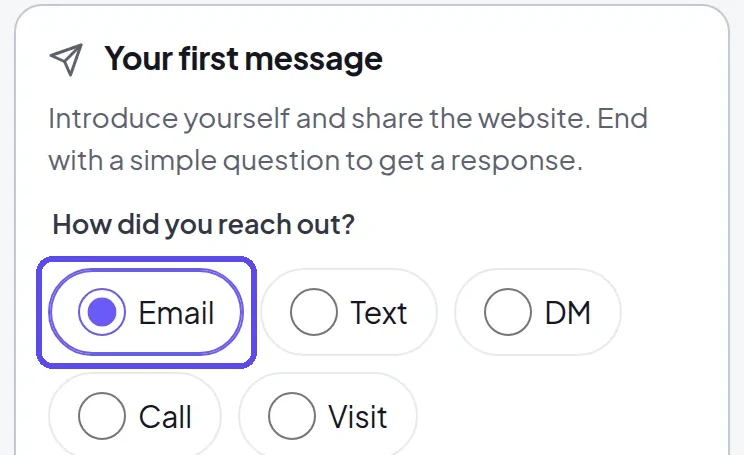
Record every call the moment you hang up, with who answered, what was said and the next step. When an owner says yes, send one approval link while the yes is fresh. A call you don't log is a callback you forget, and the owner won't remind you. In the app, you mark how you reached each business: email, text, DM, call or visit.
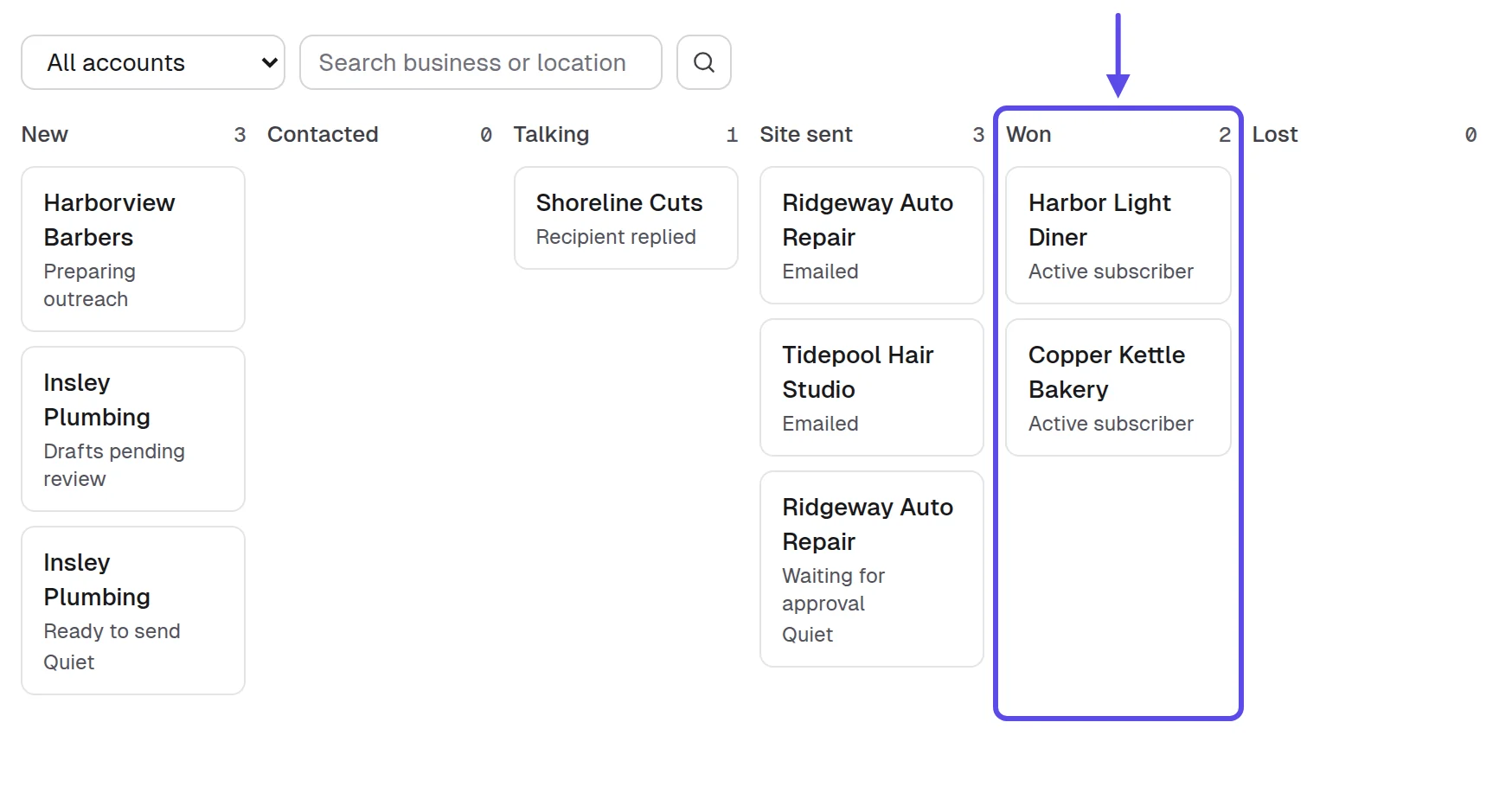
The Pipeline keeps every business by stage, from New to Won and Lost, so you can see who to call back today. Once a website is live, messages from its contact form arrive in the Inbox, alongside every other client's. Check both each morning before your first calling block, so nothing slips.
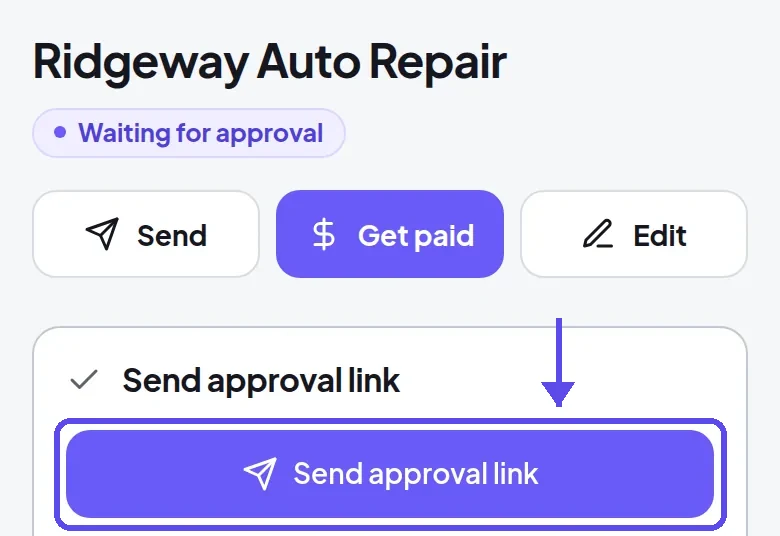
When the owner says yes, send an approval link. It opens a secure card payment page in your name, with the monthly price and any setup fee. Paying is the owner's approval of the exact website they saw. An approved website goes live at its address in a few minutes. A website that's never approved goes offline 30 days after it was built.
In Nielsen's 2021 survey, as Fortune reported it on May 5, 2023, 88% of respondents said they trust recommendations from friends over all other promotion channels. So ask every owner who approves which owner they know who needs the same. A call that opens with a client's name is no longer cold. 8
The approval message
Thanks for the call. Here's the link to approve [Business name]'s website: [Approval link]. It shows the website and the monthly price we agreed, and once it's approved, the website goes live.
By hand, in your sheet in Google Sheets, add the date, who answered, the result (owner, staff, voicemail or no answer), the next step and its date. Sort by next-step date every morning. A row with no next step is a business you've stopped calling, whether you meant to or not.
- Log every call before you dial again
- Every row has a next step and date
- Send the approval link during the call
- Check the live website on your phone
- Ask every new client who else to call
You'll know it worked when the owner approves on the call or the same day, and the business moves to Won. The website is live at its address, you've opened it on your phone, and a referral name sits on your next call list.
Tip
Call each new client a week after the website goes live. The first change you make quickly is the moment to ask who else they know.
Which mistakes make owners hang up on a cold call?
Six mistakes make owners hang up: pitching AI or design, calling at the busy hour, reading a script, arguing past a no, calling with nothing built, and calling again and again. Each one below comes with what to do instead.
- Pitching AI or design. Instead, name the gap their customers see and the fix you built.
- Calling a diner at lunch or a bakery at opening. Instead, call at the quiet hour.
- Reading a script in a flat voice. Instead, say the opener in your own words.
- Arguing after a clear no. Instead, thank them and mark the business Lost.
- Calling about a website you haven't built. Instead, build it before you dial.
- Calling the same number again and again. Instead, send one email and one follow-up.
These mistakes have one thing in common: the call is about you, not about the owner's business. Every fix moves the call back to their customers, their gap and their website. If you're ever unsure what to say next, go back to the gap.
How do you know your cold calls are working?
Six counts tell you: owners reached, links opened, looks booked, voicemail replies, approvals and referrals. Track them in the Pipeline or a sheet. These aren't targets. They're things to count every week, and each one below says what to change when it's weak.
- Owners reached: how many of your calls the owner answers. If weak, change the hour you call, not the script.
- Links opened on the call. If weak, ask permission earlier and draft the message before you dial.
- Looks booked. If weak, offer two times to choose from instead of asking when suits them.
- Replies after a voicemail. If weak, say their business name first and your number twice.
- Approvals after owners see the website. If weak, rebuild the first screen around the gap you named.
- Referrals from clients you reached by phone. If weak, ask on the week-one check-in call.
If calls stay weak after you've changed the hour and the opener, try another channel for that business type. Some owners would rather read than talk. Our post on where to sell websites compares email, texts, visits and calls side by side.
Frequently asked questions
Does cold calling for websites work?
Yes, cold calling works when every call is about a website already built for that business and the call's job is to get the owner to open the link. It fails as a pitch for a service the owner can't see. Owners say yes to what they can open on their own phone.
Is cold calling better than email for selling websites?
Neither alone: the strongest approach is a call, then one email the same day with the link. A call gets a live answer, and an email lets the owner look again later with their staff. Use the call to get the link opened and the email to keep it within reach.
Should you leave a voicemail on a cold call?
Yes, leave one short voicemail with your name, their business name, what you built and that the link is coming by email. Say your number twice, slowly, then send the email the same day. That way, an owner who never answers unknown numbers still gets the link.
How many times should you call the same business?
Call until you reach the owner or a staff member gives you a time, and try a different quiet hour each time. Once you've spoken, send one email and one follow-up. A clear no ends it, and you mark the business Lost and move on.
Is it legal to email an owner after a cold call?
Yes, if the email meets the rules: in the US, the FTC's compliance guide to the CAN-SPAM Act says a commercial email must include your valid physical postal address and a clear way to opt out, with opt-out requests honored within 10 business days. Other countries have their own rules, and every email the app sends carries an opt-out line. 5
Should you cold call businesses that already have a website?
Yes, call them when the website has a gap the owner can see on their phone, such as a website that won't open, a security warning, an old year or no mobile layout. Skip a website that works well or credits a web designer in its footer. A designer's credit means someone is already looking after it.
Do you have to build the website before you call?
Yes, build the website first, because the call's job is to show it, and a build from the business's own listing takes minutes. A website that's never approved goes offline 30 days after it was built. So build for the businesses you'll call this week.
Sources
- Pew Research Center, “Most Americans don’t answer cellphone calls from unknown numbers” (December 14, 2020; a survey of 10,211 US adults, July 13 to 19, 2020)
- Clutch, “The State of Small Business Websites in 2025” (a survey of 406 US small business owners, August 5, 2025)
- Clutch, “The Small Business Growth Playbook for 2025” (Clutch and Drive Research, a survey of 500 small and midsize business decision-makers)
- Ironstone, Lead finder’s searches and results for partners (our own accounts left out), October 8 to November 17, 2026, from our own records read November 20, 2026
- Federal Trade Commission, CAN-SPAM Act: A Compliance Guide for Business
- Rio SEO, 2025 Local Search Consumer Behavior Study (US consumers; Business Wire, May 21, 2025)
- CX Dive, “Customers back up their initial searches for local businesses with reviews” (July 11, 2025), on a survey of more than 1,000 US consumers
- Fortune, “When it comes to building trust with consumers, brands need to put customer satisfaction first” (Eamon Barrett, May 5, 2023), on Nielsen’s 2021 survey
- web.dev (Google), “Web Vitals”