 Ironstone
A freelancer website is your own page as the person who builds and looks after websites for local businesses. An owner opens it after you show or send their finished website, to check you're real. It names the business type and town you serve, shows two or three finished websites like theirs, says how the monthly price works and gives one way to ask. One page will do, and you can build it in an evening. This guide walks through nine steps, with word-for-word lines and screens from the app.
Key facts
- In Clutch's 2025 survey, 45% of small business websites were built by outside partners, more than by in-house teams or by owners themselves. 1
- In a 2025 survey of more than 1,000 people reported by CX Dive, 83% of US consumers had used a search engine to find a local business in the past month. 2
- In a survey of 500 small and midsize business decision-makers by Clutch and Drive Research, 81% said clear and consistent communication is the most important factor when they select service providers, consultants or business partners. 3
- Between October 8 and November 17, 2026, Ironstone's Lead finder showed 6 partners 56 local businesses with a gap an owner can see (Ironstone's own accounts left out). 4
What is a freelancer website?
A freelancer website is your own website as the person who builds and looks after websites for local businesses. It's where an owner checks you're real after you show or send their finished website. It isn't a portfolio for other designers. It's written for one business owner who's deciding whether to trust you, so every line answers a question that owner has.
It holds your full name and business name, the business type and town you serve, and two or three finished websites like theirs. It also says how the monthly price works, gives one way to ask, and shows your phone and mailing address. One page can carry all of it. More pages can come later, if they ever need to.
When you sell AI websites to local businesses, you build the owner's website first and show it to them on a phone. Your freelancer website is the second thing they open, often that same evening. It rarely starts the sale. It backs up the conversation you already had, so the owner can check that what you said holds up.
Why does a freelancer who sells to local businesses need a website?
Owners hire outside people to build their websites, they look people up online, and they choose whoever communicates clearly. A freelancer with no page of their own asks an owner to trust a stranger they can't look up. That's a big ask when the owner is about to pay every month. The three survey figures below show why each part matters.
of small business websites were built by outside partners in Clutch's 2025 survey, more than by in-house teams or by owners themselves. The owner you meet already expects to hire someone, and your page shows it can be you. 1
of US consumers had used a search engine to find a local business in the past month, in a 2025 survey of more than 1,000 people. An owner looks you up the same way their customers look them up. 2
of small and midsize business decision-makers, in a survey of 500 by Clutch and Drive Research, call clear and consistent communication the most important factor when they select service providers. A page that answers the owner's questions before they ask is that communication. 3
The finished website you built for the owner wins their attention. Your own website keeps it. An owner who searches your name and finds nothing, or finds a page about something else, tends to stop replying. The rest of this post builds the page that keeps them reading and talking to you.
What do local owners check on a freelancer website?
Owners check five things: that you build for businesses like theirs, that you're nearby, that the websites you show are finished, how the price works, and how to reach a person. The table gives what your page says for each one, word for word. It's written for a partner selling to plumbers in Kestrel Bay, WA, a fictional town.
| What the owner checks | What your page says, word for word | Where it goes on the page |
|---|---|---|
| Do you build for businesses like mine? | Websites for plumbers in Kestrel Bay, WA, built before you pay. | The first screen, as the headline |
| Are you nearby? | Based in Kestrel Bay, a short drive from your shop, with a visit to show you your website on your phone. | Under the headline |
| Are the websites finished? | Insley Plumbing (a sample): the call button, the hours and the services on the first screen. | Under each example |
| How does the price work? | One monthly price covers your website, its hosting and the changes you ask for. Cancel any time. | The price section |
| Can I reach a person? | Ask for a website for your business and get a reply the same day. | The one button, and the short form under it |
An owner usually opens your page on their phone between jobs, at the counter or on a bench at lunch. They're busy and half watching the door. If the page is slow, says nothing about their kind of business or hides how to reach you, they close it. Your message goes with it.

Which rules apply to your business name, your licenses and your emails?
Three rules touch this work: a business name that isn't your own may need registering as a DBA, the requirements for licenses and permits vary with what you do and where, and commercial email must follow the CAN-SPAM rules. The table gives each rule in its source's words and where to read it. This isn't legal advice.
| What you do | What the source says | Where to read it |
|---|---|---|
| Your page shows a business name that isn't your own (a DBA) | The SBA says a business name that isn't your own may need registering as a DBA (a trade name or assumed name) with the state, county or city. 6 | See the SBA's guide to licenses and permits, on a DBA, trade name or assumed name |
| You need licenses and permits for your business activities and your location | The SBA's guide to licenses and permits says the requirements and fees vary with your business activities, your location and the government's rules. 6 | See the SBA's guide to licenses and permits and the SBA's local assistance for where you work |
| You send a commercial email, such as a cold email or a follow-up email | In the United States, the FTC's compliance guide to the CAN-SPAM Act says a commercial email must include your valid physical postal address and a clear way to opt out, and opt-out requests must be honored within 10 business days. 5 | The FTC's CAN-SPAM Act compliance guide for business |
- Before your page shows a trade name (a DBA), read the SBA's guide to registering a business, then find out whether your state, county or city takes the filing, and file it there. 6
- To learn the requirements and fees, use the SBA's guide to licenses and permits and the SBA's local assistance, and ask about a city or county business license, a home-occupation permit and sales tax on websites. 6
- Every commercial email, cold or follow-up, carries your postal address and a clear opt-out, with opt-out requests honored within 10 business days under CAN-SPAM. 5
The postal address on your freelancer website and in your email signature should be the same valid physical postal address CAN-SPAM asks every commercial email to carry. Use the name you registered as a DBA if it isn't your own. For anything about licenses and permits in your town, the offices in the SBA's guides can answer your questions. 5
How do you build a freelancer website that wins local clients in 9 steps?
Pick who it's for, choose your name, write the first screen, show finished websites, explain your price, give one way to ask, check it on a phone, get found and keep it current. All nine fit an evening of a web design side hustle, by hand or in the app.
1. Who is your freelancer website for?
Your page is for one business type in one town. A page for "small businesses everywhere" says nothing to a plumber in Kestrel Bay. An owner trusts the freelancer who already knows their customers' questions: the call button for a plumber, the menu for a diner, today's bake for a bakery. One type, one town is also the page that's quickest to write, because every line has one reader.
Here's the twist. The business type decides your headline, your examples and your price wording, so choose it before you write a word, not after the page is done. Pick the type with the highest count of gaps you can see in your town, not the type you like best. A page about the right type keeps working while you sleep.
Search "[type] near [town]" in Google Maps for three business types. Open the first twenty listings for each and count the ones with no Website button. Write the three counts in a sheet in Google Sheets, one row per type. The highest count is the type your page names first, and those listings are your first list of owners to build for.
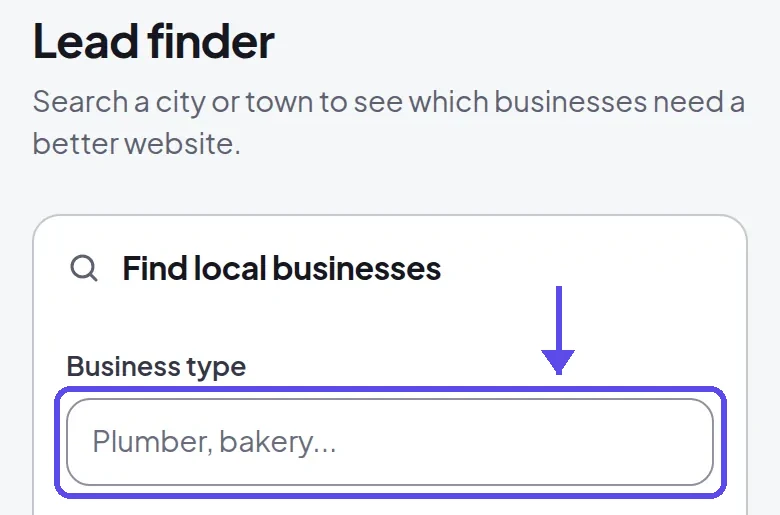
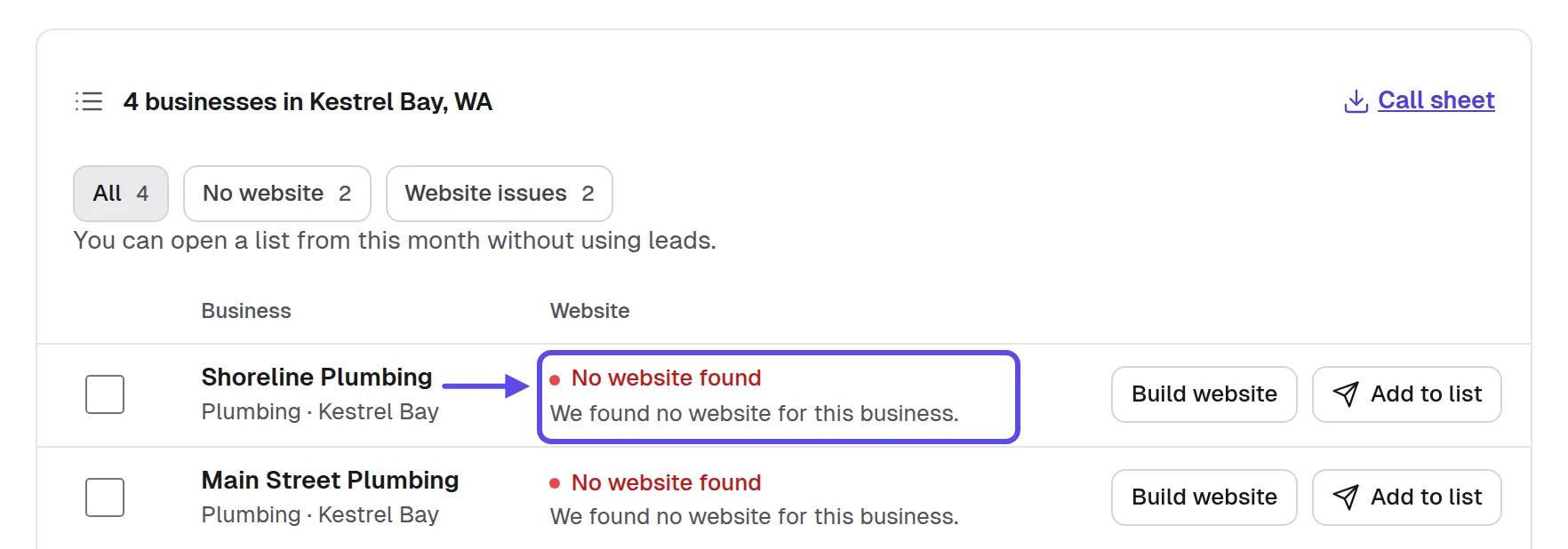
Lead finder, the app's business lookup tool, searches a business type in a town and labels each business: No website found, Social listing only, Website won't open, Outdated website or Delivery page only. In Ironstone's own records, partners ran 54 Lead finder searches between October 8 and November 6, 2026, and the middle one returned 17 local businesses, with Ironstone's own accounts left out. One search shows how many businesses your page could speak to. 4
- Customers search for this business type before they call or visit.
- You counted the gaps for at least three types.
- Your type has the highest count of listings without websites.
- The town is one you can drive to this week.
- You can say what a website does for this type.
You'll know it worked when you can finish the sentence "Websites for [type] in [town]" without stopping. You'll also have a list of real businesses of that type in your town to build for.
Tip
Write for the first type only. A second type gets its own page later, made from the first one in an hour.
2. What name will you sell under?
Sell under your own full name, or one business name an owner can say back to their partner. Owners remember a person, so your full name shows up even under a business name. The same name goes on your page, every message, the payment page and the footer of every client website you sign. That one name is what an owner searches when they want to check you.
The twist: the name on the payment page has to match the name on your freelancer website and your first message. An owner who sees three different names hesitates at the exact moment of paying. So pick one name and one email address before you build anything, and never change them in the middle of a sale.
Open a new document in Google Docs and write the five details every page and message repeats: full name, business name, email address, phone number and mailing address. Then search the business name you picked to see whether a local business already uses it. If it isn't your own name, read the DBA row in the rules section above before you put it on your page.
The app writes a first message in your name, and the approval link opens a secure card payment page in your name too. Your storefront, the page where a business can ask you for a website, carries the same name. That's how it works for Harbor Web Co., a fictional web studio, whose name matches on all three.
About-you lines
I'm [Your full name], and under [Your business name] I build and look after websites for [business type] in [town].
I build your website first from your own listing, show it to you on your phone, and you pay only if you want it live.
[your phone number], [your mailing address]
- One name used on every page and message.
- Your full name visible under a business name.
- One email address used for every owner.
- A valid mailing address on the page.
- No local business already uses the name.
It worked when an owner reading your message, your page and the payment page sees the same name on all three. They can also find your phone number in ten seconds.
Tip
A name with your town in it tells an owner you're local before they read a word. Keep it short enough to say on the phone.
3. What should the first screen of your freelancer website say?
The first screen says who you build for, where, and what happens next, in a headline, one line under it and one button. An owner gives a page a few seconds before deciding whether to scroll. Everything else, like your story and your tools, goes lower down or nowhere at all. If it doesn't help the owner say yes, it doesn't belong on the first screen.
The twist: write the headline about the owner's customers, never about design or AI. "Customers find your hours and call you from their phone" beats "Modern AI web design" every time. An owner buys what their customers will do, so the first screen names that. Design is how you get there, and the owner doesn't need to hear about it.
Sketch the first screen on paper first. Then build it and open it on your phone, and on a laptop and a tablet side by side. The headline, the line under it and the button must all show before any scrolling on all three, and the phone counts most, since that's where owners open it. If something pushes the button down, move it lower or cut it, then check again.
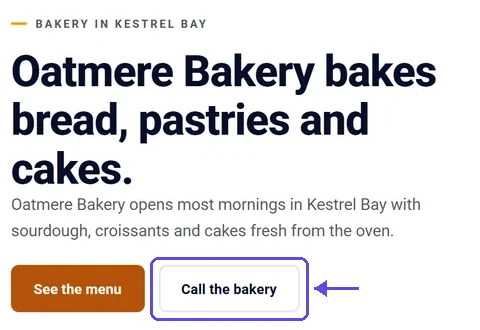
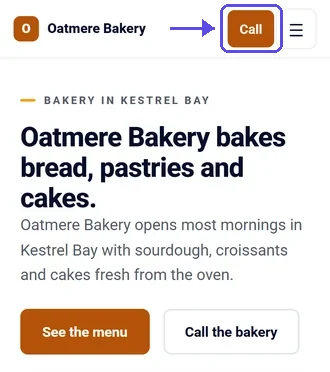
The client websites the app builds follow the same rule. The website for Oatmere Bakery, a fictional bakery, shows See the menu and Call the bakery on its first screen. Use your best client website as the model for your own first screen: one promise and one action, with nothing in the way.
First screen lines
Websites for [business type] in [town], built before you pay
[Your full name] builds your website from your listing, shows it on your phone and looks after it every month.
See a website like yours
Ask for yours
- The headline names a business type and town.
- The line under it says what happens next.
- One button shows before any scrolling.
- No word about AI or design tools.
- It fits your phone, plus a laptop and a tablet.
Ask someone who runs a business to read your first screen for five seconds. If it worked, they can say back who you build for, where, and what to tap, without looking at the page again.
Tip
Read the headline aloud to an owner you already know. If they ask "so what do you do?", write it again.
4. Which finished websites should your freelancer website show?
Show two or three finished websites for businesses of the type you serve, each one tappable on a phone. Owners judge you by a website they can open, not by a list of skills. One strong example of their own type does more than ten of other types. A plumber wants to see a plumber's website, with a call button they can tap.
The twist: label every example honestly. It's either a client's live website shown with the owner's permission, or a sample built for a fictional business and called a sample. A website that's never approved goes offline 30 days after it was built. So never link a real business's unapproved website from your page.
Open each example on your phone and on a laptop, and take a screenshot of each first screen. Under each one, write a line with the business type, the town and what a customer can do first, like call, see the menu or book a car in. A screenshot keeps your page working even if a link changes.
In the app, a build brings in the business's public listing and its current website, with real hours, services and photos, and the website is marked Ready to send. In Ironstone's own records, Lead finder showed 6 partners 56 local businesses with a gap an owner can see between October 8 and November 17, 2026, and 28 of them had no website it could find. Ironstone's own accounts were left out. Your examples speak to owners like those. 4
Example caption
[Business name], [business type] in [town]: [what a customer does first] from the first screen
Built and looked after by [Your full name] at [Your business name], shown with the owner's permission.
A sample built for a fictional business, to show what your website could look like.
- Every example is of the type you serve.
- Each client example shown with the owner's permission.
- Every sample is called a sample.
- No link to an unapproved real business website.
- One caption line under each example.
It worked when an owner taps an example on their phone and says "mine could look like that." And nothing you show belongs to a business that didn't agree to it.
Tip
Swap a sample for a real client's website as soon as an owner agrees. A real business from their own town beats any sample.
5. How do you explain your price on your freelancer website?
The price section says one monthly price, what it covers, any setup fee and how to cancel. Decide the number first. The post on what to charge for a website walks you through it, one step at a time. Then your page explains how the price works before an owner has to ask, which saves an awkward question on the first call.
GoodFirms' survey of more than 100 web development companies put a small business website at $1,000–$7,000, set up in 1 to 12 weeks. An owner who has heard a quote like that wants to know what your monthly price includes and when they pay it. Answer both on the page, in plain words. 7
The twist: say what the owner never pays for. There's no bill before they've seen their finished website. That one sentence answers the fear owners bring from past quotes. It's also the line owners repeat to their partner when they talk it over that night.
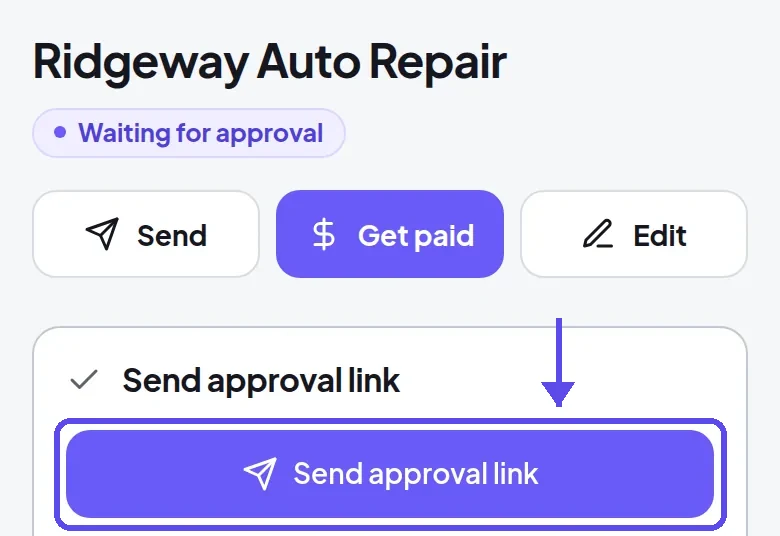
When an owner is ready, an approval link opens a secure card payment page in your name, with the monthly price and any setup fee. Paying is the owner's approval of the exact website they saw. What you pay Ironstone is on the pricing page. The price on your page and on the payment page must match.
Price section
One monthly price, no bill before you see your website
[monthly price] a month covers your website, its hosting and the changes you ask for.
A one-time setup fee of [setup fee] when your website goes live.
Cancel any time by replying to any message or calling [your phone number].
- The monthly price decided before the page goes live.
- What's included every month is listed.
- The setup fee shown, or none charged.
- How to cancel in one sentence.
- The page price matches the payment page.
Owners who reach you have read the price section, so they ask about their website, not about the cost. Nobody is surprised when they open the payment page, because it says what your page said.
Tip
Say the price once on the page, in one place. A price repeated in three sections reads like a sales sheet.
6. How does an owner ask you for a website?
An owner asks through one button and a short form with three fields: their name, their business and a phone number. Every extra field loses some owners, who are often filling it in on a phone between customers. Ask everything else when you call them back. By then you're already talking, and the questions feel like part of the call.
The twist: answer a request the same day with their finished website if you can build it, not with a questionnaire. An owner who asked for a website and gets their own website back the same day stops comparing anyone else. A questionnaire asks them to do work. A finished website shows you already did it.
Make a ten-minute event in Calendly and put its booking link on your page and in your reply. Save your reply as a template in Gmail, under Settings, Advanced, Templates, so each answer takes a minute. Then log every request in your sheet with the date and time it came in. That log shows how fast you answer, week by week.
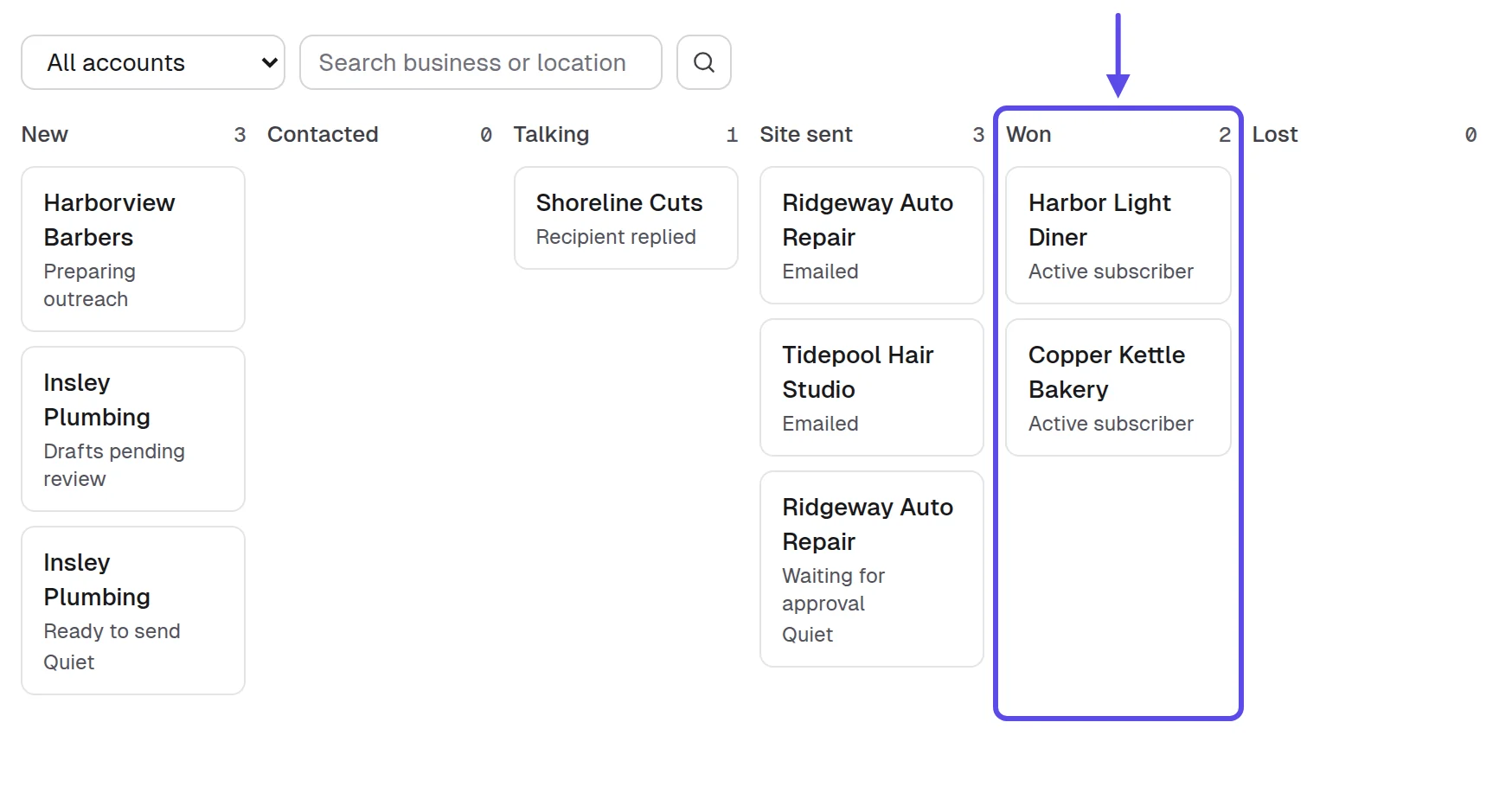
In the app, your storefront is a page where a business can ask you for a website. The Pipeline keeps every business you're talking to by stage, from New to Won and Lost. A request lands in New, so no request waits unseen while you're busy with a build.
Reply to a request
Subject: Your [Business name] website is ready to see
Hi [Owner name],
I'm [Your full name] from [Your business name]; thanks for asking about a website for [Business name].
I've built a first version from your listing, and it works on a phone: [Website link]
If you want it, I'll put it live and look after it every month; pick a ten-minute call here to go through it: [Booking link]
If you'd rather not hear from me again, reply "no thanks" and I won't write again.
[Your full name], [Your business name], [your mailing address]
- One button above the fold and below.
- Three fields on the form, no more.
- A reply the same day, every time.
- A ten-minute booking link in the reply.
- Every request logged with its date.
Send a test request from your own phone. It worked if it reaches you, gets the saved reply within the hour and shows up as New in your Pipeline or sheet.
Tip
Send yourself a test request every month. A form that quietly stopped working costs you the owners who trusted it.
7. Does your freelancer website work on a phone?
It has to, because owners open your link on their phone, often in the evening after closing. Check it on your own phone before anyone else does. Scroll it with one thumb and look at the headline, the examples, the button and the price section. If any of them is hard to read or reach, fix it first.
In Pew Research Center's survey of January 30 to June 18, 2026, 91% of US adults owned a smartphone. Your page gets read on a phone first and a laptop second. So the phone version is the one to get right, before you polish anything else. 8
Paste your page's address into PageSpeed Insights and read the Mobile tab. Google's web.dev says a page's largest content should load within 2.5 seconds, and a page should answer a tap or click within 200 milliseconds, for a good user experience. If the report misses either one, make the photos smaller first. Then run the report again to see whether it passes. 9
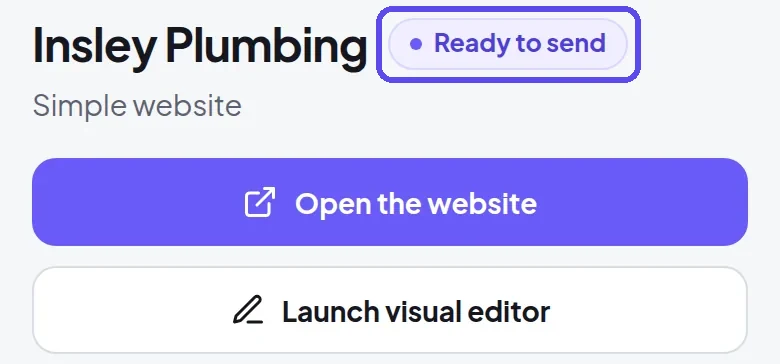
Open each client example in the app on your own phone. The website's page shows it's marked Ready to send. Then tap the call button and the menu or service links on every example your page links to, so nothing an owner taps is broken.
- The button shows on a phone without scrolling.
- Text reads without pinching or zooming.
- The Mobile tab passes in PageSpeed Insights.
- Every example link opens on a phone.
- Your phone number calls when tapped.
On your own phone, using mobile data, you can open the page, tap an example and call yourself from it in under a minute. If any step stalls, that's the one to fix next.
Tip
Check the page on the oldest phone you can borrow. Owners don't all carry new ones.
8. How do owners find your freelancer website?
Owners find it through your messages, your own listing and the owners who already know you. Put your page's address everywhere an owner meets you: every email, your signature and your printed flyer. The places you find web design clients are the places your address belongs, so it goes wherever you go looking.
The twist: Google says it can take a few weeks for it to notice a new site or changes to an existing one. So don't wait for search to send owners to you. Link your page from every message from the first day, and let search catch up. 10
Set up a Google Business Profile for your own web design service, with your town as the area you serve and your page in the website field. Then add your page in Google Search Console and use URL Inspection to ask Google to look at it. Both take one evening, and you set each one up once. After that, keep the name on both the same as on your page.
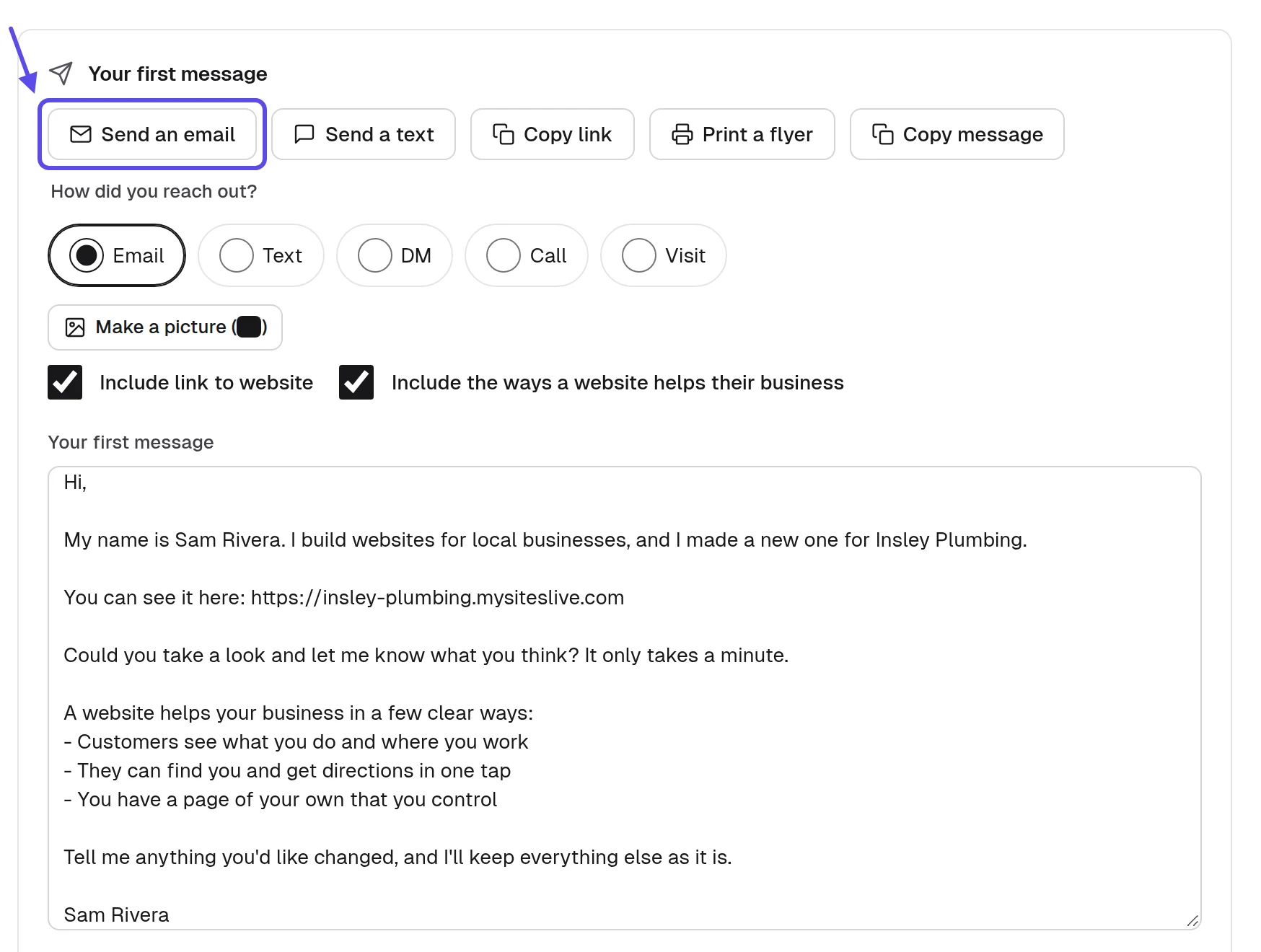
The app writes a first message in your name, with the link to the owner's finished website. End every message with your signature. Then the owner who wants to check you is one tap from your freelancer website, and they don't have to search for it.
Your email signature
[Your full name], [Your business name]
Websites for [business type] in [town]: [Your website address]
[your phone number], [your mailing address]
Your profile description
[Your business name] builds and looks after websites for [business type] in [town]. Each website is built first from the business's own listing and shown on the owner's phone. The owner pays monthly only if they want it live.
- Your page address in every email signature.
- The address printed on every flyer.
- A Google Business Profile with the website field filled.
- The page added in Google Search Console.
- The same name everywhere the address appears.
Owners mention your page before you do, saying something like "I saw your website." And once Google has noticed it, searching your business name shows your page among the first results.
Tip
Ask every owner you meet how they checked you out. Their answer tells you where your address matters most.
9. How do you keep your freelancer website current?
Add each new client, keep the examples recent and update the page every month. In Clutch's survey of 406 US small business owners on August 5, 2025, 40% of small businesses without a website relied on referrals as their main source of leads. The owner who hears about you from a friend checks your page before they call. 11
The twist: in Nielsen's 2021 survey, as Fortune reported on May 5, 2023, 88% of respondents said they trust recommendations from friends over all other promotion channels. One sentence from a client owner, with their permission and business name, does more than a paragraph about you. So ask for it once their website is live. 12
On the first of each month, open your page on your phone and read it as an owner would. Keep a dated list in Google Sheets of what you changed: a new client example, a quote, a town added. A page with this year's work on it reads as active, and owners notice.
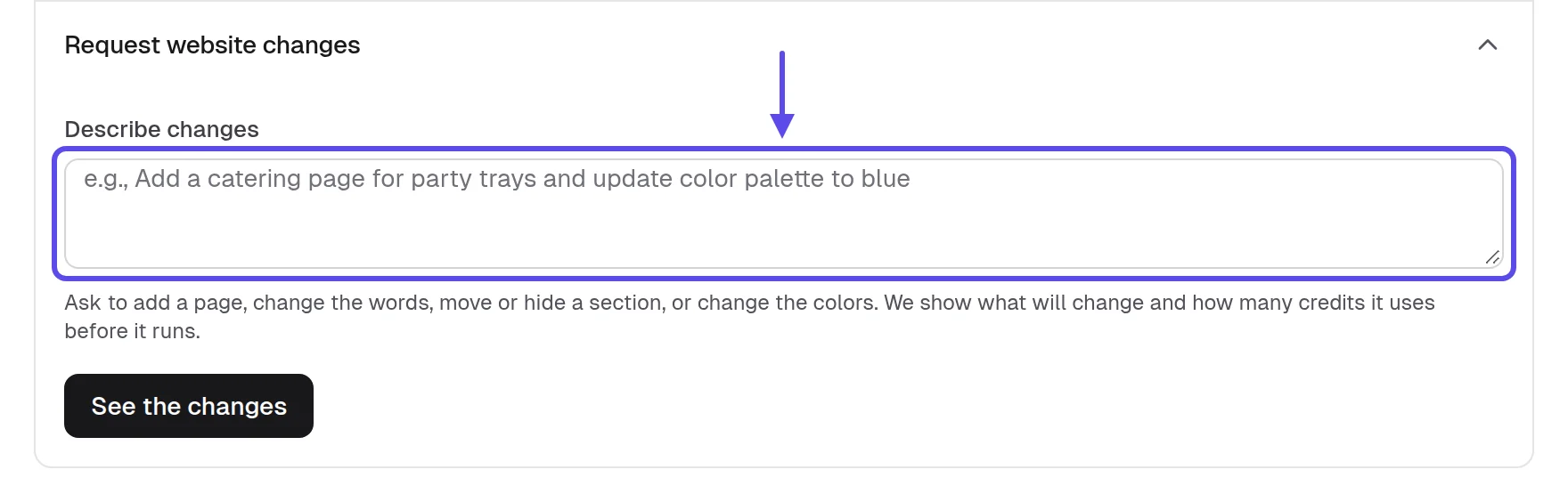
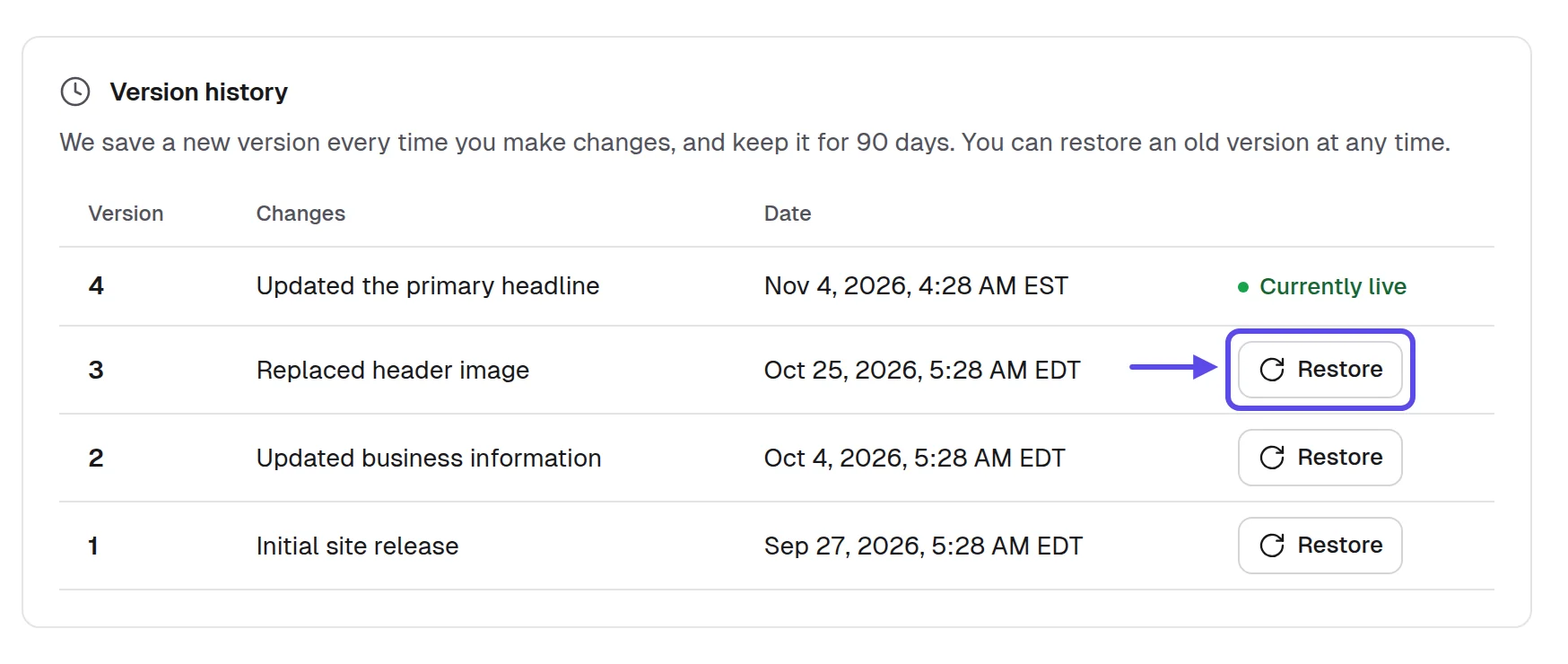
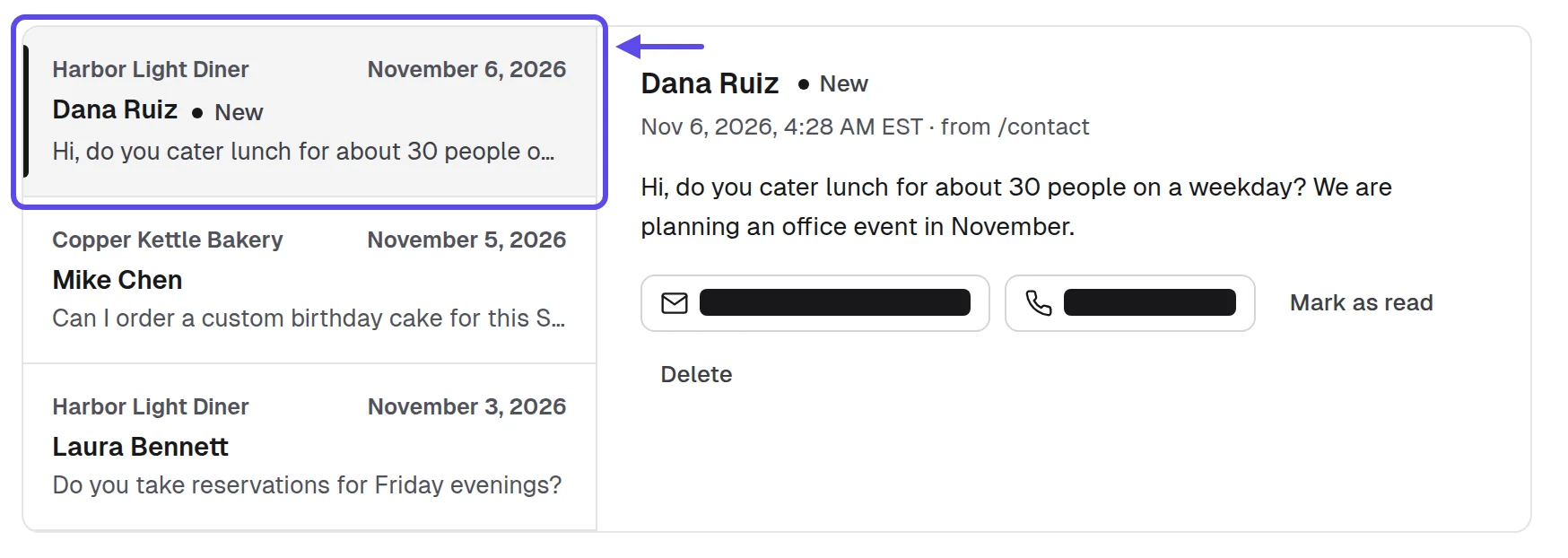
In the app, you ask for a change in plain words and the website updates in a few minutes. Every change is saved as a version you can bring back if you don't like it. Messages from every client website's contact form arrive in the Inbox. When an owner writes about their new customers, that's the line to quote, so ask their permission.
Asking for a quote
Subject: One line from you for my website
Hi [Owner name],
It's [Your full name] from [Your business name]; could I put one sentence from you about [Business name]'s website on my own website, with your business name?
Here's a line you can change or replace: "[Their words]"
If you'd rather not, reply "no thanks" and I won't ask again.
[Your full name], [Your business name], [your mailing address]
- A dated monthly check on your phone.
- Each new client added with permission.
- One client quote with a business name.
- No example older than this year's work.
- A saved version before every big change.
It worked when your page shows at least one real client from your town, in their own words. And your monthly list in the sheet has no gap, month after month.
Tip
Ask for the quote the week a client's website brings its first message. Owners say the kindest things right then.
What do freelancer website examples look like for different business types?
It's the same page, rewritten for each business type. A plumber page leads with calls, a bakery page with today's bake, a diner page with the menu and hours, and an auto repair page with booking a car in. The table below gives every line word for word for Kestrel Bay, WA, a fictional town.
When you sit with an owner, open the version of your page for their business type on a laptop and turn it toward them. Let them point at what they'd change on their own website. The example shows them where their customers' first tap goes, and they start picturing their own.

| Business type you serve | Headline | Line under it | Button |
|---|---|---|---|
| Plumbers | Websites for Kestrel Bay plumbers that put the call button first | Your customers call you from the first screen and see the areas you serve. | See a plumber's website |
| Bakeries | Websites for Kestrel Bay bakeries that show today's bake | Customers see the menu, your hours and how to order before a holiday. | See a bakery's website |
| Diners | Websites for Kestrel Bay diners with the menu and hours up top | Guests check what's on and when you're open, then call or walk in. | See a diner's website |
| Auto repair shops | Websites for Kestrel Bay auto repair shops that book cars in | Drivers see your services and call to book a car in from their phone. | See an auto repair website |
Keep one version of your page for each type you sell to, and link the matching version in each first message. Change the town and the services to the ones you know first-hand. An owner spots a line copied from somewhere else, and stops trusting the rest.
Which mistakes make a freelancer website lose local clients?
Six mistakes cost local clients: writing for other designers, showing unfinished or borrowed work, hiding how the price works, giving no way to reach a person, a page that's slow on a phone, and a name that differs from your messages. Each fix below takes an evening or less.
- Writing about tools and design trends. Fix it by naming the owner's customers and what they tap.
- Linking a real business's website the owner never approved. Show only approved clients or labeled samples.
- Hiding how the price works. Add the price section, with what's included and how to cancel.
- A long contact form. Cut it to name, business and phone number, and ask the rest later.
- A page that fails the Mobile tab. Make the photos smaller and cut extra sections.
- A different name on the page and the payment page. Use one name everywhere.
These mistakes usually show up the first time you read your page on your phone, as an owner would. Fix the one an owner mentions first. Owners rarely mention a second, so their first comment is the one worth acting on today.
How do you know your freelancer website is working?
Owners ask you for websites through it, mention it in conversation and approve after reading it. Count each in the Pipeline or a sheet. These are things to count, not targets, and each sign below says what to change when it's weak.
- Requests through the page each month. If there are few, change the headline to name one business type and one town.
- Owners who say they looked you up. If they looked and went quiet, replace samples with real clients from your town.
- Approvals from owners who read your page. If they're low, rewrite the price section to say no bill before they see their website.
- Hours from request to reply. If it's over a day, save the reply as a template and answer from your phone.
- The Mobile tab result in PageSpeed Insights. If it fails, make the photos smaller and remove sections owners never scroll to.
Change one thing at a time and note the date in your sheet. That way you know which change moved the count. Give each change a few weeks before you judge it, since owners don't all reply on the same schedule as you.
The best sign of all is an owner who forwards your page to another owner. When that happens, ask both of them for a line you can quote. Then add the new business to your examples, once its owner agrees to it.
Frequently asked questions
Do freelancers who sell websites need their own website?
Yes, a short one. Owners look up whoever offers to build their website, and a page naming the business type, the town and finished examples answers what they're checking. One page is enough to start, and you can add to it as you go.
What should a freelancer website include?
It should include your full name and business name, the type and town you serve, two or three finished websites, how the monthly price works, one way to ask, and your phone and mailing address. Anything else can wait until an owner asks for it. Keep it to one page at first.
Can my storefront be my freelancer website?
Yes, to start with: your storefront is a page in your name where a business can ask you for a website, so it covers the basics. When you have your first clients, add your own page with examples and the price section.
Should I show my price on my freelancer website?
Yes, show how the price works: one monthly price, what it covers and how to cancel. Show the number too if you're ready to say it. Owners who read "no bill before you see your website" bring fewer worries to the first call.
What do I show before I have any clients?
Show samples built for fictional businesses, each one called a sample. Never show a real business's website the owner hasn't approved, which goes offline 30 days after it was built anyway. Replace samples with real clients as soon as owners agree.
Do I need to register a business name for my freelancer website?
Only a name that isn't your own may need it. The SBA's guide says a business name that isn't your own may need registering as a DBA (a trade name or assumed name) with the state, county or city. Selling under your own full name avoids the question. 6
How long until my freelancer website shows up on Google?
Google says it can take a few weeks for it to notice a new site or changes to an existing one. In the meantime, link your page from every message and your email signature, so owners reach it without searching. 10
Sources
- Clutch, “83% of small businesses now have a website” (press release, August 21, 2025)
- CX Dive, “Customers back up their initial searches for local businesses with reviews” (July 11, 2025), on a survey of more than 1,000 US consumers
- Clutch, “The Small Business Growth Playbook for 2025” (Clutch and Drive Research, a survey of 500 small and midsize business decision-makers)
- Ironstone, Lead finder’s searches and results for partners (our own accounts left out), October 8 to November 17, 2026, from our own records read November 20, 2026
- Federal Trade Commission, CAN-SPAM Act: A Compliance Guide for Business
- US Small Business Administration, “Apply for licenses and permits” (business guide)
- GoodFirms, website construction costs survey of more than 100 web development companies (press release, February 9, 2024)
- Pew Research Center, “Mobile Fact Sheet” (survey of US adults, January 30 to June 18, 2026; October 19, 2026)
- web.dev (Google), “Web Vitals”
- Google Search Central, “Get your website on Google”
- Clutch, “The State of Small Business Websites in 2025” (a survey of 406 US small business owners, August 5, 2025)
- Fortune, “When it comes to building trust with consumers, brands need to put customer satisfaction first” (Eamon Barrett, May 5, 2023), on Nielsen’s 2021 survey