 Ironstone
The best niches for selling websites are local trades and shops whose customers look them up before they call or visit: plumbers, roofers, auto repair shops, salons and barbers, restaurants, bakeries and landscapers. In these types, the owner decides alone, many have a gap the owner can see, and a website has one clear job. Still, no list beats a count in your own town. This guide gives you eight checks to score each niche, and a one-week test to try it.
Key facts
- Between October 8 and November 17, 2026, Lead finder, Ironstone's business lookup tool, showed 6 partners 56 local businesses with a gap an owner can see, not counting Ironstone's own accounts. 1
- In a 2025 survey of more than 1,000 people reported by CX Dive, 83% of US consumers had used a search engine to find a local business in the past month. 2
- The Census Bureau's 2022 Nonemployer Statistics counted 29.8 million US businesses with no paid employees. 5
- In Clutch's 2025 survey, 45% of small business websites were built by outside partners, more than by in-house teams or by owners themselves. 4
- In the Census Bureau's Business Trends and Outlook Survey (story of May 26, 2026), less than 20% of US firms with four or fewer employees reported using AI. 7
What makes a business type a good niche for selling websites?
A good niche is a business type whose customers search before they call or visit. The owner decides alone, and many businesses of the type have a gap the owner can see. A website has one clear job for them, and you can reach them in person. And a niche is a type in a place, like plumbers in your county, not an industry label.
| Business type | What customers look up first | What the website does first |
|---|---|---|
| Plumbers | A number they can call right now about a leak | Puts the call button at the top of the first screen |
| Roofers | Whether they cover the customer's area, and photos of past roofs | Asks for an estimate request with the address |
| Auto repair shops | The repairs they do and whether a car can be booked in | Lists the services and takes a booking |
| Salons and barbers | The price list and the next open appointment | Takes the booking without a phone call |
| Restaurants | The menu and tonight's opening hours | Shows the menu and the hours before anything else |
| Bakeries and cake shops | What's fresh today and how to order a custom cake | Takes orders before a holiday or a birthday |
| Landscapers | The area they serve and photos of finished yards | Asks for a quote with photos of the yard |
The table shows example types that pass the checks. Read each row the way their customer would, phone in hand. The six traits below are what to look for in any type, including the ones the table leaves out. Your town may have others.
- Customers search on a phone for the type before they call or visit.
- The owner runs the business and decides alone, with no head office above them.
- Businesses of the type often have no website, an old one or only a social page.
- A website has one clear job: calls, bookings, orders, menus or estimate requests.
- Your county has enough businesses of the type to keep you busy for months.
- You can drive to them, so you can show a website in person.
Before you choose, sit at your desk with a notebook beside your laptop. Write down the business types you pass on your own streets every week. Then mark the ones you understand as a customer. That handwritten list is where the eight steps start.

Why does your niche decide how fast you sell websites?
Your niche decides how fast you sell because it decides whether customers look the business up first and whether the owner can see what a missing or broken website costs. In a type where customers search first, the gap shows the moment you point at it. Three survey figures below show why.
of US consumers used a search engine to find a local business in the past month, in a 2025 survey of more than 1,000 people. In a niche where customers search first, a missing website is a lost customer. 2
of US consumers are unlikely to visit a business whose online listing has wrong information, in a 2025 local search study. Types whose hours or menus change often lose more than others to a wrong listing. 3
of small businesses still had no website in Clutch's 2025 survey. Over a third of those say a website isn't relevant to them, and a finished one in front of them can answer that. 4
Types whose hours, menus or prices change through the year, like restaurants, bakeries and salons, get hurt the worst when a listing is wrong. Their owners are often the ones who value a website that someone else keeps up to date for them.
In the Census Bureau's Business Trends and Outlook Survey (story of May 26, 2026), less than 20% of US firms with four or fewer employees reported using AI. So the smallest businesses are the least likely to build a website with AI on their own. For an owner who doubts they need one, point to the post on does a small business need a website. 7
How many local businesses in a niche have a gap you can show?
There's no set figure for a niche. The count that matters is the one you take for one business type in your own town, and the numbers below show you what to look for. Lead finder, Ironstone's business lookup tool, showed 6 partners 56 local businesses with a gap an owner can see between October 8 and November 17, 2026, not counting Ironstone's own accounts. Those 56 split four ways: 28 had no website found, 16 had an outdated website, 6 had only a social or directory page, and 6 had only a booking or ordering service. 1
The table below sorts the same 56 businesses by what Lead finder found on each listing. Each row is its own count from those 56, so don't add the rows up. Read each row as a check you can run on one listing, and as the thing you'd show the owner. 1
| What Lead finder found | Businesses (of 56) | What you point to when you show the owner |
|---|---|---|
| A listing whose website and name-based web addresses did not open | 14 1 | Tap the listing's Website button together and watch it fail to open |
| No website on the listing, and the web addresses matching the name belonged to someone else | 9 1 | Type the business name as a web address and show whose page opens |
| A website without a secure connection | 7 1 | The browser's warning beside the address, on the owner's own phone |
| A website whose newest year was 2021 or earlier 1 | 6 1 | The old year at the bottom of the home page |
| Only a social or directory page for a website | 6 1 | The page with no hours and no call button where a customer looks |
| Only a booking or ordering service where a website should be | 6 of 56 1 | The service's page, carrying another company's name above theirs |
| A website with no mobile layout | 5 1 | The page on the owner's phone, pinched and zoomed to read the hours |
These totals mix business types and cover partners' searches across several towns, so they can't pick a niche for you. To do that, run the rows yourself. Choose one business type in your town, open its listings, and mark each one against the table. If many listings won't open or show no website, that's a niche where the first talk with the owner is short. If the type is full of current websites, it isn't your first niche this month.
How do you pick a niche for selling websites in 8 steps?
You pick a niche with eight checks, from search demand to a one-week test, run on two or three types side by side. Each step shows how by hand and where the app helps. After that, the guide on how to sell AI websites to local businesses takes over.
1. Which business types do customers look up before they call?
Customers look up the types they need fast or choose with care. That's a plumber for a leak, a mechanic for a broken car, a restaurant for tonight, a salon for a haircut or a bakery for a birthday cake. They search on a phone and pick from what they find. A type people find only by word of mouth gains less from a website.
Here's the twist: ask what the customer types into the search box, not what the owner sells. A search like "emergency plumber near me" or "cake for Saturday" tells you the website's first screen before you build it. A type with plenty of searches like that and few good websites is your niche.
To check by hand, open Google Trends, choose Explore and set the region to your state. Compare searches for two or three business types over the past year. Look for steady interest and for seasons, like heating repair before winter or landscaping in spring. Write each type's busy season beside it in your notebook.
Then ask owners you already know, like your barber or your mechanic, what their customers ask on the phone. The questions they repeat are what a website in that trade has to answer. The two lines below are what to say.
Ask owners you know
What do your customers ask you on the phone that they could read online before they call?
Which other owners in your trade have trouble with their website? Would you mind if I said you sent me?
- Customers search for the type on a phone first
- You know what customers type into the search box
- Each type's busy season is written beside it
- An owner you know told you what customers ask
- You can picture the website's first screen
It worked when you have two or three business types written down in your notebook. Beside each one is the search a customer types and the season when that search is busiest.
Tip
Start with types you've been a customer of yourself. You already know what you looked for, and what you couldn't find.
2. Which of those business types can you reach in your own town?
The types you can reach are the ones within an afternoon's drive, in numbers that last for months. A niche you can visit lets you show a website in person, and it makes "local" true when you say it. A type with only a handful of businesses in your county runs out before you've learned it. So look for types that are both close and plentiful.
The twist is when owners are in. Plumbers and landscapers work at customers' homes, so you rarely find them in a shop. Salons, bakeries and restaurants have quiet hours when you can walk in. Before you choose, write on your paper calendar which afternoons you could visit each type of business.

By hand, open County Business Patterns and pick your own county. The tool lists industries by formal name and code, not everyday words like plumbers or salons. So search its industry list for a word like plumbing or bakery, pick the closest match, and write down its code. Then read the number of establishments for that industry in your county. Write that count beside each business type in your notebook. If you want to go further than a count, the SBA's guide to market research and competitive analysis explains how to size a local market.
In the app, run a Lead finder search for each type in your town to see how many local businesses come back. For a sense of scale, between October 8 and November 6, 2026, 54 Lead finder searches by 7 partners returned 735 local businesses, and the middle search returned 17. Partners' own test accounts were left out. 1
- You can drive to them in an afternoon
- Your county has enough businesses of the type
- You know when owners have time to talk
- You know if they work from a shop
- Visit afternoons are blocked on your calendar
It worked when each type on your list has three things beside it: a county count, a search result count for your town, and afternoons on your calendar when you could visit.
Tip
If your own town is small, add the next town along the road you already drive. Two towns of one type beat one town of two types.
3. How many businesses in each niche have a gap an owner can see?
The number is yours to find. No list can give it, so you count the businesses with a gap an owner can see in your own town: no website, a website that won't open, only a social or delivery page, or an old site that fails on a phone. Those are gaps the owner sees the moment you point at them. A niche full of them is one where the first conversation is short, because you don't have to explain the problem.
The twist: count the first page of results, not the businesses you already know. The names you remember usually have good signs and working websites. That's why you remember them. The gaps are often in the businesses you've never heard of.
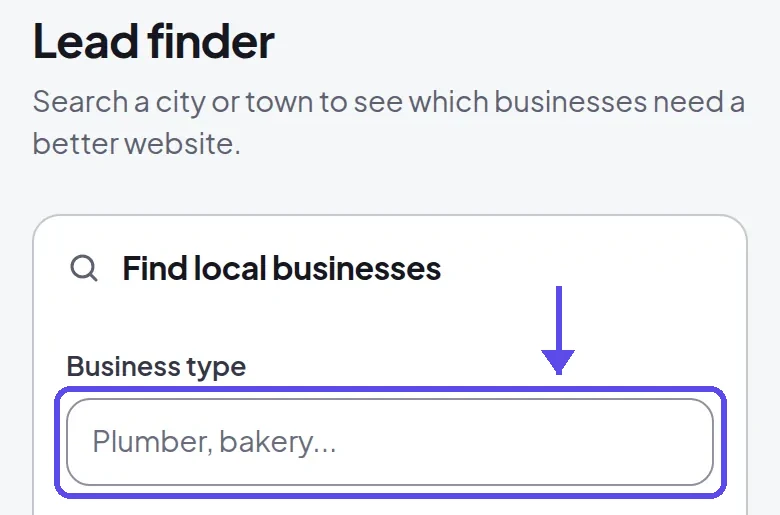
By hand, search "[type] near [town]" in Google Maps. Open each listing on the first page of results and look at its Website button. Mark each one: no Website button, a link to a social page, a site that won't open, or an old site that's hard to read on a phone. Tally the marks for each type in your notebook.
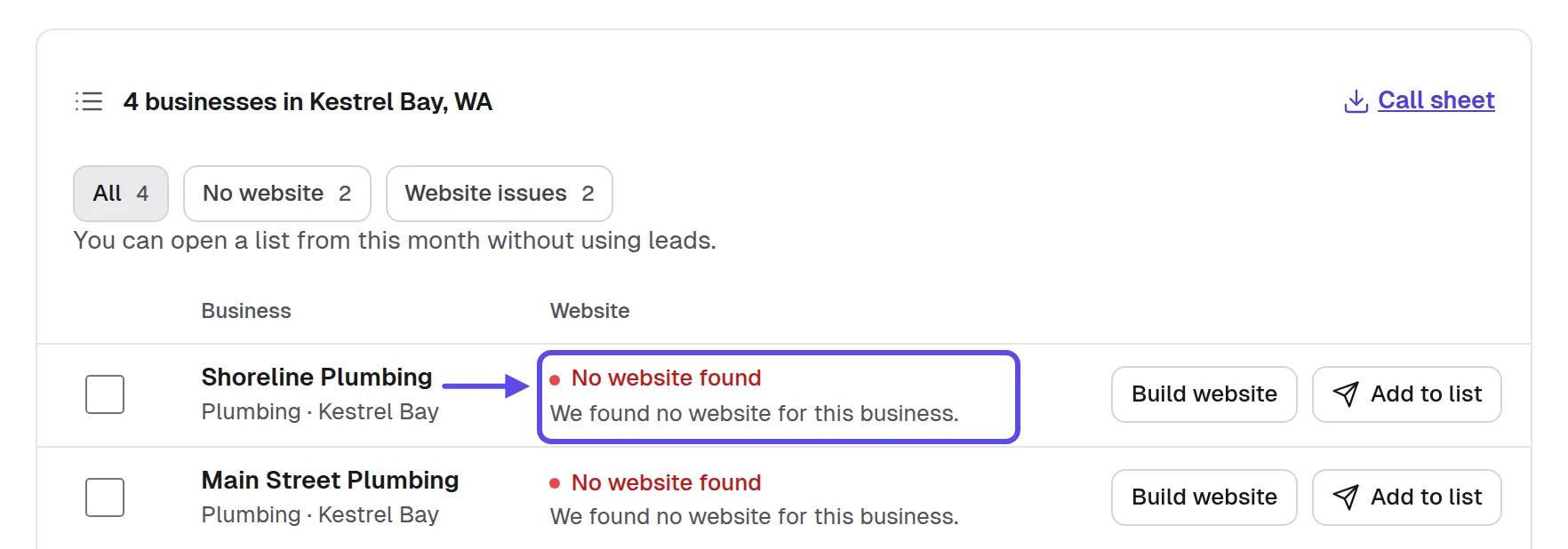
In the app, Lead finder searches a business type in a town and labels each business by what it found: No website found, Social listing only, Website won't open, Outdated website or Delivery page only. Under each label is a line you can say to the owner. Run the same search for each type on your list and compare the labels.
- Counted the first page of results, not favorites
- Marked each listing with the gap you found
- Opened each website link on your own phone
- Noted the line to say to each owner
- Compared the gap counts across your business types
It worked when you have a gap count per type from the same kind of search, and one type leads. The post on where to find web design clients covers more places to look.
Tip
Search at the hour a customer would, on your phone, not your laptop. The gap an owner feels is the one a customer meets on a small screen.
4. Does the owner decide, and is the business still open?
The owner decides when the business is independent and owner-run, and the person who answers the phone is the one in charge. It's worth your time when it shows it's open: recent reviews, current hours and a phone someone answers. Chains and franchises send you to head office. A site that credits a web designer already has someone looking after it.
The twist: in a niche of one-person businesses, the owner is also the person who reads your message. There are a lot of them, too. The Census Bureau's 2022 Nonemployer Statistics counted 29.8 million US businesses with no paid employees, against 8.3 million with paid employees in its 2022 County Business Patterns. 5
Per the Bureau of Labor Statistics, 77.7% of US private sector establishments that opened in the year ended March 2024 were still open in March 2025. So before you build for a new business, check it's still trading. 8
By hand, open a listing's reviews in Google Maps, sort them by newest and check the opening hours. For an old site, paste its address into the Wayback Machine and open its calendar of saved copies to see how long it has looked the same. Then call at a quiet hour and ask who looks after the website, using the two lines below.
Quiet-hour phone call
Hi, is this [Business name]? I'm [Your full name], I make websites for [business type] in [Town], and I'd like to know who looks after your website.
Thanks. Would it be all right if I sent the owner something to look at, and what's the best address for it?
- The business is independent, not a chain or franchise
- Has recent reviews from the last few months
- Opening hours that look current
- Someone answers the phone at a quiet hour
- No web designer credited in the site's footer
It worked when every business left on your list is open, independent and reachable. You could reach each owner this week, and you know who to ask for when you call or walk in.
Tip
A niche where the owner answers the phone is a niche where the owner reads your message. Note who picked up when you called.
5. Can you say in one sentence what a website does for them?
Yes, when the sentence names one job a customer does on it. A plumber's website gets emergency calls. A salon's takes bookings. A bakery's takes orders before a holiday. An owner buys that sentence, not the website itself. If you can't finish the sentence for a type, it isn't your niche yet, so keep it on the list and come back to it.
The twist: build one finished website for a real business in each niche before you choose. The build shows you what the type's listings already carry, like hours, services and photos, and what's missing. A type whose listings are thin will take more of the owner's time before the website is right.
By hand, open the listings of a few businesses of the type on your laptop. On paper beside it, write what a customer needs on the first screen: the call button, the menu, the booking or the estimate request. That note becomes your one sentence.

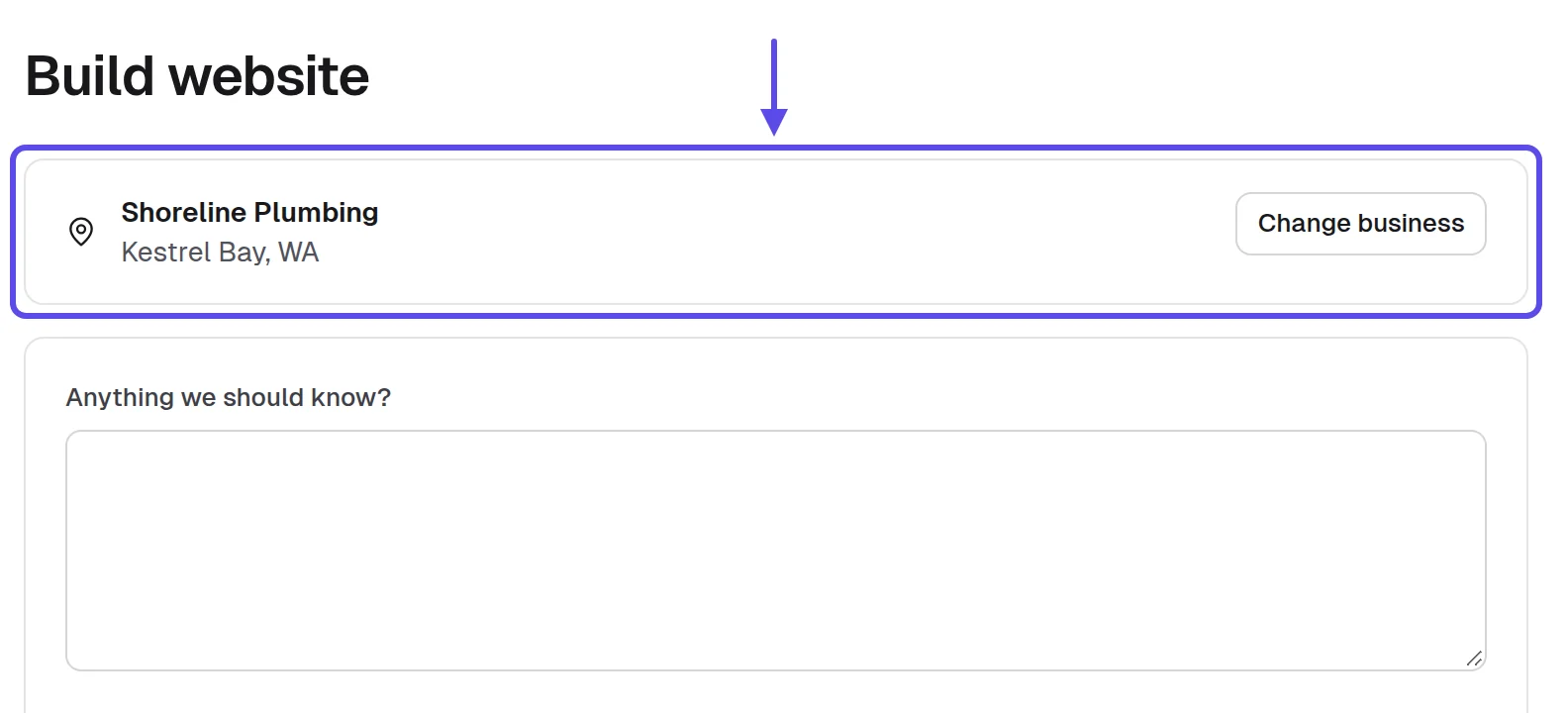
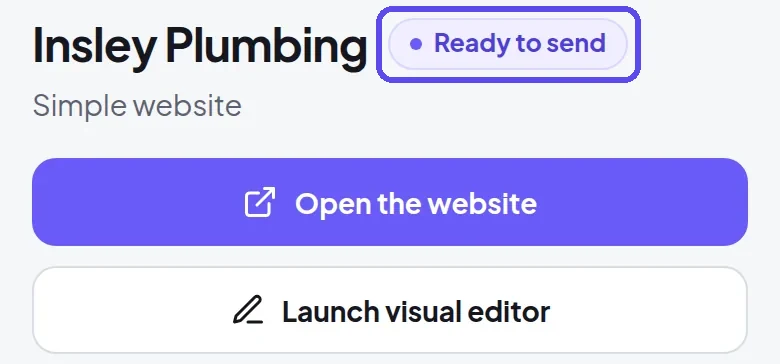
In the app, a build pulls in the business's public listing and its current website. That means the real hours, the real services and the business's own photos, not filler. When it's done, the website is marked Ready to send. A build takes minutes, so you can look it over, fix anything that's off and move on to the next owner.
- One sentence says what the website does
- One test website built for each niche
- The first screen carries that one job
- The listing had hours, services and photos
- Every fact matches what the business published
It worked when you can say the sentence for each niche without thinking. And when you open the test website on your phone, it does that job from the first screen.
Tip
Use only what the business published or told you, and never invent reviews, awards or years in business. A test website with a made-up fact teaches you nothing about the niche.
6. How do you score your niches side by side?
Put each niche in a row and the six checks in columns. Mark each check yes or no from what you found in steps one to five. The niche with more yeses than the others goes first. A written score stops you from picking the type you like over the type that's ready, which is easy to do when you're excited about a trade.
The twist: score each niche on the businesses with a gap in your town, not on the whole trade. Plumbers may pass every check on paper. But if few plumbers in your town have a gap this month, they're not your first niche right now.
| Check | Mark it yes when | Where you found it |
|---|---|---|
| Customers search first | The type shows steady searches in your state, with a season you can name | Google Trends, Explore, your state, the past year |
| Enough businesses nearby | Your county's count and your town's search results would last you months | County Business Patterns and a Lead finder search |
| Gaps an owner can see | The type had more gaps on the first page of results than your other types | Lead finder's labels or your Google Maps tally |
| The owner decides | The businesses with a gap are independent and someone answered the phone | The reviews, the hours and your call at a quiet hour |
| One clear job | You can say in one sentence what the website does for them | Your notes and the test website |
| You can visit | You have afternoons blocked when owners of this type have time to talk | Your calendar |
By hand, copy the six checks into a sheet in Google Sheets. Give it one row per niche, one column per check and a last column for the busy season. Mark each cell yes or no and color the yeses green. The greenest row is your first niche, and the next row waits for later.
The count of businesses with a gap in your county is the start of any estimate of how much money you can make selling websites in that niche. The post on that question walks through the sheet line by line, so you can fill it in with your own counts.
- One row per niche, one column per check
- Each check marked yes or no
- The busy season noted for each niche
- The niche with more yeses goes first
- The second niche kept for later
It worked when one niche stands out in the sheet. You can say why in one sentence to a friend who asks what you sell, without checking your notes.
Tip
When two niches tie, pick the one whose busy season comes first. An owner with a busy season ahead has a reason to say yes now.
7. How do you test a niche with a handful of owners?
Build finished websites for a handful of businesses with a gap in your top niche, then show or send each one in the same week and count who answers. Set the size before you start: pick only as many as you can build, show and follow up on inside that one week, all from the same niche, and write that number at the top of your sheet. A week of real replies tells you more than any list of niches can. Show the website in person where you can, and send the rest by email with a link.
The twist: send every owner in the niche the same message, changing only the business name and the gap you found. Then, if replies differ, you know the niche or the gap is the reason, not your wording. Change the words and you can't tell what worked.
In the United States, the FTC's compliance guide to the CAN-SPAM Act says a commercial email must include your valid physical postal address and a clear way to opt out, and opt-out requests must be honored within 10 business days. Other countries have their own rules. 6
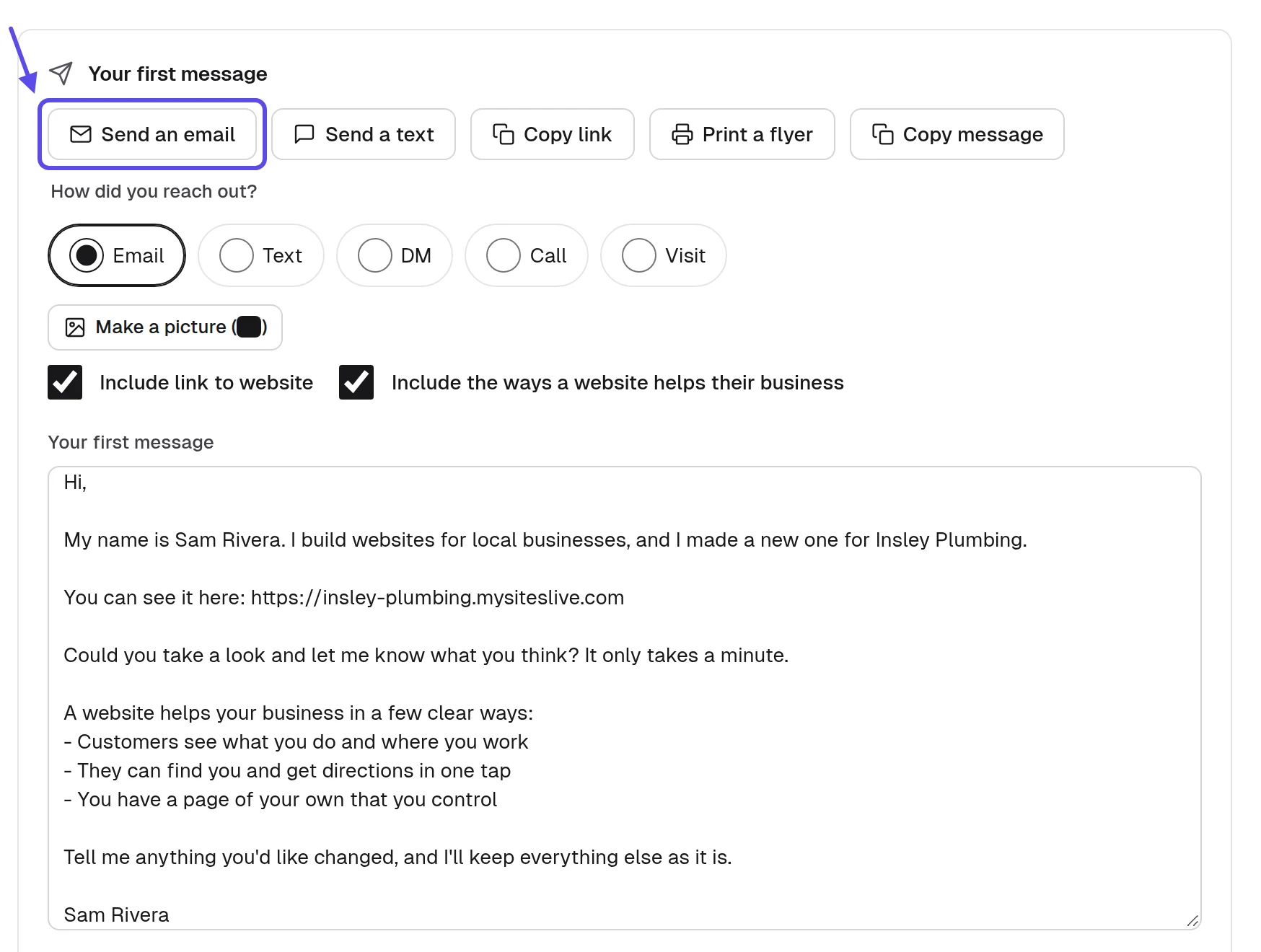
The app writes a first message in your name and lets you send it by email or text, or print a flyer. Every email carries an opt-out line. Follow-ups stop on their own as soon as the business replies to you.
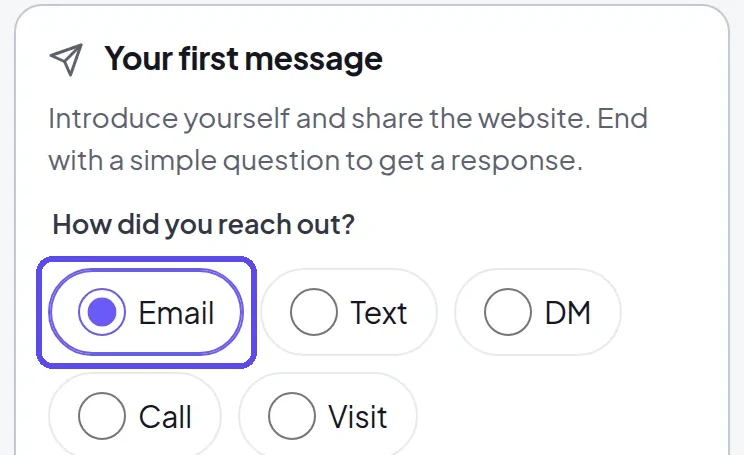
By hand, write each email in Gmail from your own address, using the two templates below. For owners you can't visit, record a short screen video in Loom. Scroll their new website on a phone and say the business name at the start. Then add the video link to the email.
Your first email
Subject: A website made for [Business name]
Hi [Owner name],
I'm [Your full name] from [Your business name]. I make websites for [business type] in [Town], and when I looked up [Business name], I found [the gap you found].
So I built a finished website for you to see, [Website link], and it works on a phone.
This is an offer: if you want the website, I can put it live and look after it every month. I'm glad to show it to you on a short call.
If you'd rather not hear from me, reply "no thanks" and I won't write again.
[Your full name], [Your business name], [your mailing address]
Follow-up email
Subject: Re: the website for [Business name]
I wanted to check whether you saw the website I built for [Business name], which I'm offering to put live and look after for you. Here it is again: [Website link]. I'm glad to change anything you'd want different for your customers.
If you'd like this to be the last message, reply "no thanks" and it will be.
[Your full name], [Your business name], [your mailing address]
- A handful of finished websites in one niche
- The same message, changing only name and gap
- Your mailing address in every email
- A clear way to say no thanks
- Only one follow-up, a few days later
It worked when, by the end of the week, every owner in the test has seen or been sent a finished website and you've written down each answer, silence included. Read it against your number: any question, change request or yes earns the niche another week. An owner who never opened your message hasn't tested the niche, so don't count that silence as a no.
Tip
Test one niche at a time. Two niches in one week give you two half-answers.
8. When do you stay with a niche and when do you switch?
Stay when owners who see their website reply and some approve. Switch when owners see it and say no for the same reason, or when the businesses with a gap run out. An owner who never opened your message hasn't judged the niche yet. So count only the owners who saw the website, and leave the rest out of your score.
The twist: owners in one trade know each other. They buy from the same suppliers and meet at the same events. A happy plumber's word reaches other plumbers, so a niche gets easier with each client. Switching after a slow first week throws that away before it has a chance to start.
By hand, add four columns per niche in Google Sheets: seen, replied, approved and the reason for each no. Fill them in as replies come in. When the same reason repeats, answer it in your first message before you think about switching.
In the app, your storefront is your own page with your name on it, where a business can ask you for a website. Once you settle on a niche, write it for that type, with your sentence from step five at the top.
Ask for a referral
Who else in [trade] do you know whose customers can't find them online?
May I tell them you sent me, so they know I'm not a stranger?
Your niche storefront line
[Your business name] builds and looks after websites for [business type] in [Town], made for [the website's one job], with changes made when you ask.
See a finished website for your business before you pay anything.
- Seen, replied and approved counted per niche
- The reason for every no written down
- Every happy client asked who else they know
- Your storefront written for your one niche
- The second niche ready if the first runs out
It worked when you can say why you're staying or switching from your own sheet. The answer names a reason owners gave you, not a feeling you had after a slow day.
Tip
Before you switch, change one thing: the gap you lead with or how you show the website. If the same no comes back, the niche is the reason.
Which niches should you skip at first?
Skip chains and franchises, types where nearly every listing links to a current website, and types customers find by word of mouth alone. Skip businesses whose website credits a web designer, and types you can't visit. Each one is a no before you start.
- Chains and franchises, where head office decides the website, not the person you meet
- Types where nearly every listing already links to a current, working website
- Types customers find by word of mouth, not by searching on a phone
- Businesses whose website footer credits a web designer who already looks after it
- Types you can't visit, because they're too far away or never in a shop
Often an owner's reply tells you to skip, with a line like "head office does our website" or "my nephew made it." Read each reply as it comes in, phone in hand, with your laptop open beside it. Write the reason beside the business in your sheet.

An owner who says they don't need a website isn't a reason to skip a niche. In Clutch's 2025 survey, over a third of small businesses with no website said a website isn't relevant to them. The reply below answers that with the finished website, not an argument. 4
When it seems unneeded
Your customers look you up before they call. I'd like to show you what they find now, and what they'd find with this.
It's already built and costs nothing to look at. If it doesn't help your customers, you can say no and I won't ask again.
How do you know your niche is working?
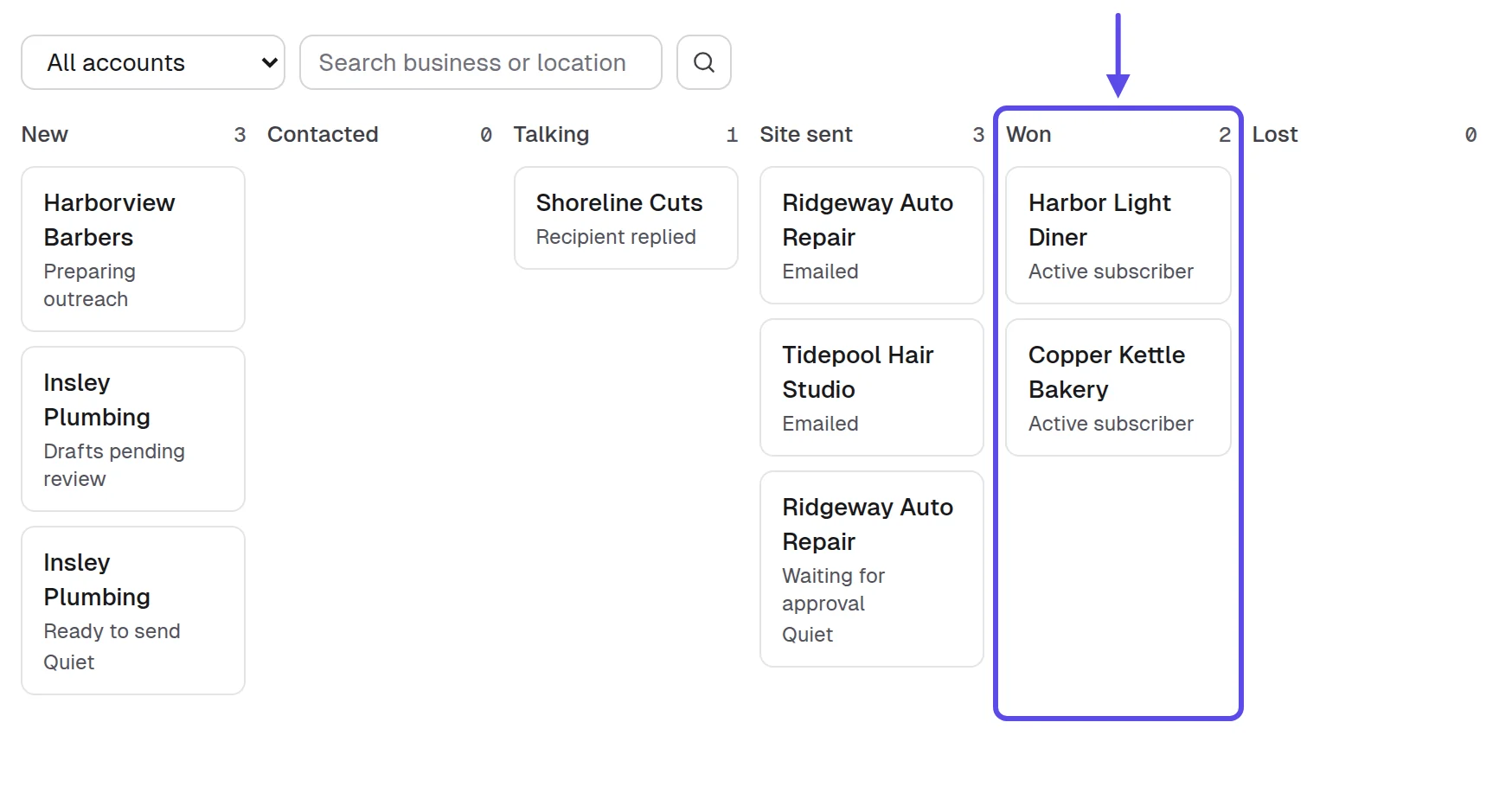
It's working when owners in the niche reply, approve, stay and send you the next business. Track the six signs below in the Pipeline or a sheet, with what to change when one is weak. Messages from client websites' contact forms arrive in the Inbox, which shows customers are using them.
- Replies to your first message; when they're weak, change the gap you lead with
- Approvals from owners who saw their website; when weak, show it in person or by video
- The same objection repeating; answer it in your first message, then think about switching
- Businesses with a gap left nearby; when they're running low, add the next town
- Referrals within the trade; when there are none, ask every happy client the question
- Contact form messages in the Inbox; when there are few, move the call button higher
Change one thing at a time, and give it a few weeks before you judge it. A niche rarely fails on every sign at once. The weak sign tells you which step to go back to, from the gap you count to the way you show the website.
Frequently asked questions
What is the best niche for selling websites?
The best niche is the business type in your own town whose customers search first, whose owner decides alone and where you count more gaps than in other types. A local trade like plumbing or roofing, or a shop like a bakery or a salon, often passes these checks. But your own count decides.
Should I pick one niche or several?
Pick one niche to start. One type means the same questions, objections and pages every time, so you get better at it with each owner. Add a second type once the first has paying clients, and reuse what you learned.
Is a niche with no websites better than one with old websites?
Both work, for different reasons. A business with no website needs one most, while an owner with an old one already believes in it. Of the 56 businesses with a gap Lead finder showed partners between October 8 and November 17, 2026 (Ironstone's own accounts left out), 28 had no website it could find and 16 had an outdated one. 1
Are the same niches good for a cold email business?
Yes, the same checks pick the niche, and email adds rules of its own. In the United States, the FTC's compliance guide to the CAN-SPAM Act says a commercial email must include your valid physical postal address and a clear way to opt out, and opt-out requests must be honored within 10 business days. Other countries have their own rules. 6
How long should I test a niche before I switch?
Test until a handful of owners in the niche have seen a finished website and given you an answer, not for a set number of days on the calendar. A niche judged on messages that nobody opened hasn't been tested yet, because no owner has seen what you made.
Can I sell websites to a niche I know nothing about?
Yes, once you learn what its customers look up first. Ask an owner you know in that trade what customers ask on the phone, and read the listings of a few businesses. Then build one test website before you choose the niche.
What if someone else already sells websites to my niche in my town?
It's a sign that owners in the niche pay for websites, not a reason to leave. In Clutch's 2025 survey, 45% of small business websites were built by outside partners. Skip the businesses whose site credits a designer, and go to the ones with a gap. 4
Sources
- Ironstone, Lead finder’s searches and results for partners (our own accounts left out), October 8 to November 17, 2026, from our own records read November 20, 2026
- CX Dive, “Customers back up their initial searches for local businesses with reviews” (July 11, 2025), on a survey of more than 1,000 US consumers
- Rio SEO, 2025 Local Search Consumer Behavior Study (US consumers; Business Wire, May 21, 2025)
- Clutch, “83% of small businesses now have a website” (press release, August 21, 2025)
- US Census Bureau, “Census Bureau Statistics Shed Light on Self-Employment by Sector and State During Small Business Week” (May 6, 2025), on the 2022 Nonemployer Statistics and County Business Patterns
- Federal Trade Commission, CAN-SPAM Act: A Compliance Guide for Business
- US Census Bureau, “Large Firms With at Least 20 Employees Biggest AI Users” (May 26, 2026), from the Business Trends and Outlook Survey
- US Bureau of Labor Statistics, Business Employment Dynamics, “Table 7. Survival of private sector establishments by opening year”