The best masonry websites lead with the work: a finished chimney or a matched brick repair in a photograph the crew took, before-and-after pairs, and an assessment request beside them. They load the gallery in about two seconds on a phone. Below are three live examples of one contractor at three budgets, each measured.
What do the best masonry websites lead with?
The picture. A homeowner cannot judge mortar, but they can judge a before-and-after pair in one glance.
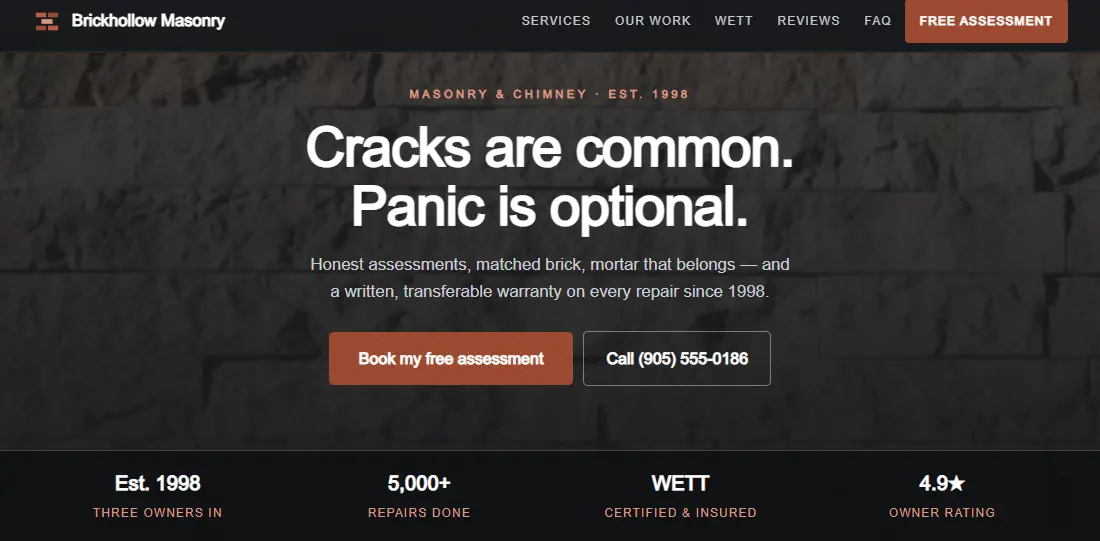
Masonry is the trade where the photograph is the pitch. A cracked chimney next to the same chimney rebuilt says more than a paragraph about inspections, and a matched-brick repair that a homeowner cannot find in the photo is the whole sales argument. The Professional masonry demo opens with a hero of finished stonework and reaches the gallery within two scrolls.
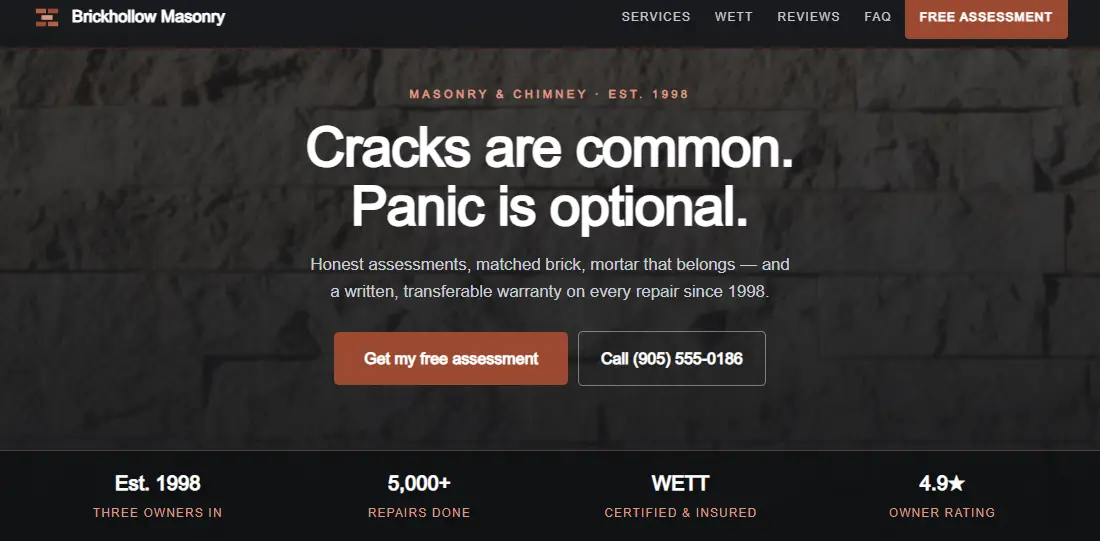
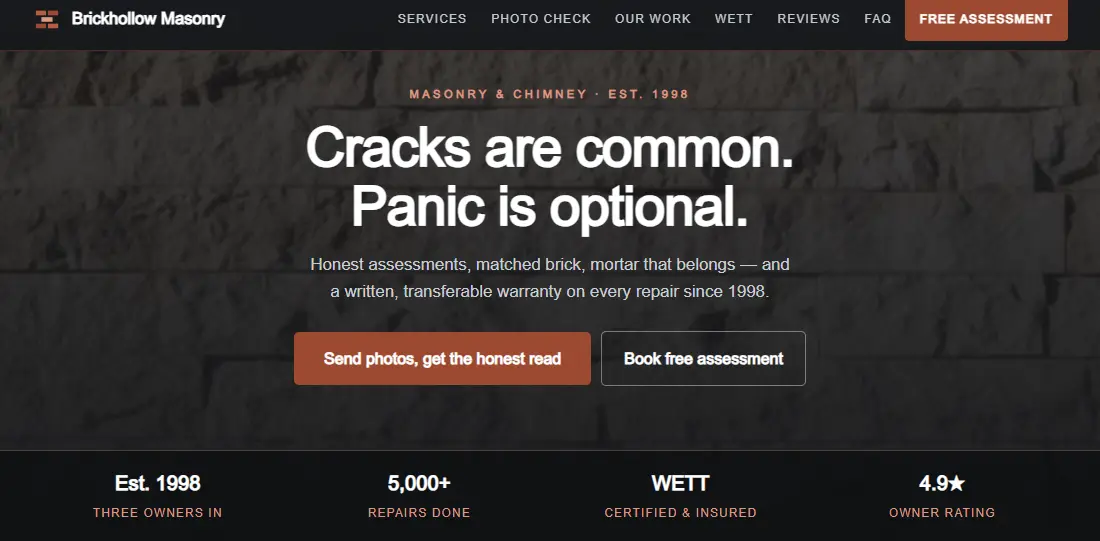
The three Brickhollow demos below are the same fictional mason at Starter, Professional, and Premium. Each was measured with Lighthouse on mobile under simulated throttling on the deployed page.
How does a gallery sell brickwork?
Pairs, captions that name the job and the town, and photographs sized for the screen so the page does not stall.
A gallery of six single photographs is a mood board. A gallery of before-and-after pairs is a portfolio, because the homeowner sees the problem they have and the result they want in one frame. The demo's captions name the job and the town, which is what a homeowner scans for to decide whether the mason works near them and has done their kind of repair.
The photographs are compressed to the size they are shown at, which is the part most masonry sites miss: a gallery of camera-size images is the reason so many trades sites score under 40 on a phone. The gallery article covers the sizing and the pairing, and the Starter demo shows the strip version on a single page.
How fast do they load, measured?
The three demos measured 99, 98, and 99 on mobile, with the main image painted in about 2.1 seconds.
Starter scored 99 with the largest image at 2.16 seconds. Professional scored 98 at 2.16. Premium scored 99 at 2.07. Those are the slowest main images of any Ironstone demo, because the hero is a large piece of stonework, and they are still under the two-second line that decides whether a homeowner waits. Sixteen local trades websites Ironstone measured under identical conditions in August 2026 averaged 37, none reached 90, and their main images took 3.5 to 27.6 seconds.5
The Professional demo shipped at 85 before the speed pass and measured 98 after it. Fonts served from the site, the hero preloaded, every image over 100 KB recompressed. The photographs did not change; their file sizes did.
What to copy first?
The before-and-after pairs, the town in every caption, and an assessment request that accepts a photo.
Pairs are a photography habit, not a design feature: take the picture before the first brick comes out. Captions with the town are one line each. The photo-upload request is the piece that changes the first call, because the mason arrives knowing what the crack looks like, and the cost guide shows which tier carries it.
Judge the gallery on a phone in a driveway, because that is where the homeowner will see it first.
What does the Starter tier leave out?
The gallery page with pairs, the chimney-inspection section, and calendar booking. It keeps six photographs, the number as a link, and the speed.
The Starter masonry demo is three pages with a strip of photographs on the home page rather than a gallery page of its own, an assessment form rather than a calendar, and no section on chimney inspections. Reviews appear as a block. The hero is the same piece of finished stonework, compressed the same way, which is why the page measured 99 on mobile, one point above the Professional build.
For a one-crew mason whose jobs start with a search and a phone call, that is a working site: the work is visible, the number dials, and the request form reaches the inbox. Professional earns its price when the before-and-after pairs and the photo request start turning night-time searches into booked assessments without a callback.
The masonry showroom has the three demos live; every demo on the floor was measured the same way before it went live.
Every demo on the floor is live and clickable.
Open the masonry demosSources: 1. BrightLocal Local Consumer Review Survey 2026 · 2. DreamHost Consumer Survey 2026 · 3. Northwestern University Spiegel Research Center · 4. Portent site-speed conversion study · 6. CallRail Home Services Marketing Report 2026 · 7. MGH restaurant diner survey · 5. Ironstone testing of 16 local trades websites, identical mobile conditions, Aug 2026.